
In the world of machine learning, imagine a symphony orchestra performing a complex piece. Each instrument plays a role — some dominate the melody while others subtly support harmony. Similarly, every feature in a dataset contributes to the model’s final prediction. But how do we know which features are the…
-
-
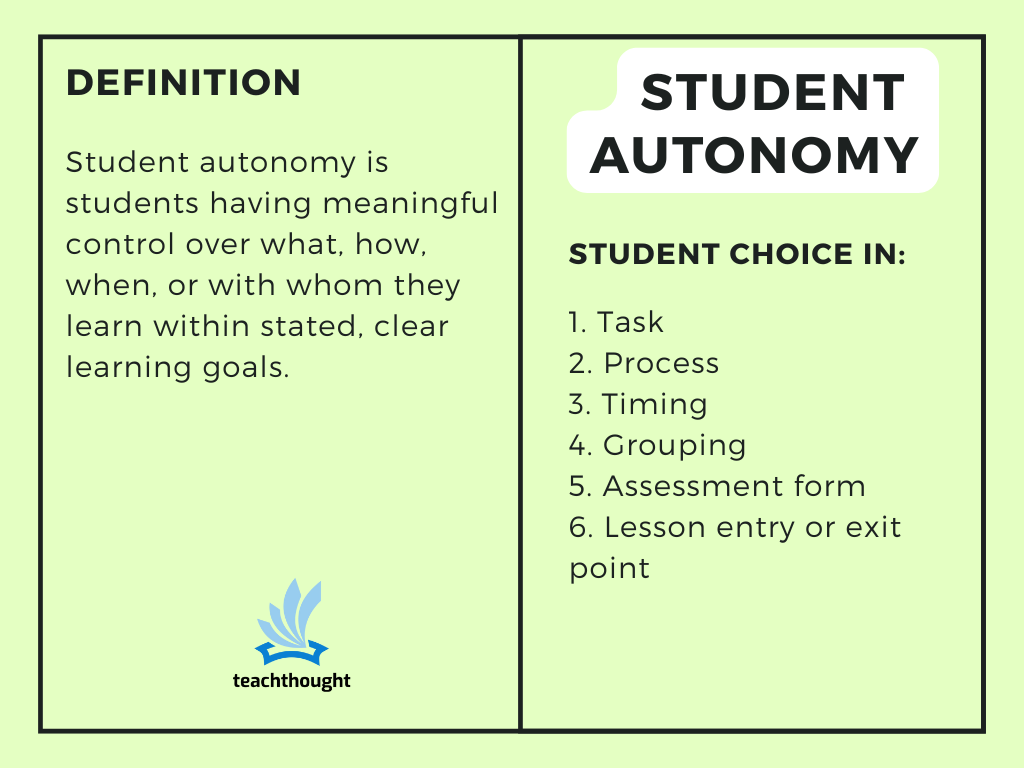
Definition: Student autonomy is students having more meaningful control over what, how, when, or with whom they learn. Student Autonomy Definition Student autonomy is students having meaningful control over parts of their learning within clear goals — what to work on, how to show learning, when to complete tasks, or…
-
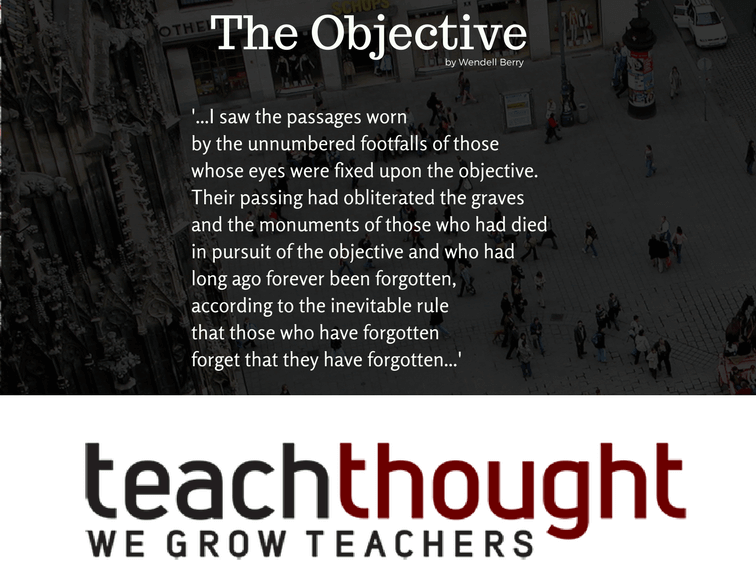
by Terry Heick I recently attended a screening of a documentary on Wendell Berry at the Louisville Speed Art Museum. Drew Perkins and I took in what was then called ‘The Seer’ back in July. Now titled ‘Look and See” out of, if I’m not mistaken, Berry’s reluctance to be…
-

As many Literature/ELA teachers know, T.S. Eliot’s The Love Song of J. Alfred Prufrock is a worth teaching for any number of reasons, from mood and narrative form to voice, tone, and the internal monologue. The poem’s images and language (diction) make it useful to even explore relatable ideas like…
-

12 Teacher Productivity Tools That Actually Save Time Time is the scarcest resource in a teacher’s day. Good tools protect that time. Great tools give it back. The goal is not more apps. The goal is fewer clicks, clearer plans, faster feedback, and smoother teamwork. This list focuses on tools…
-
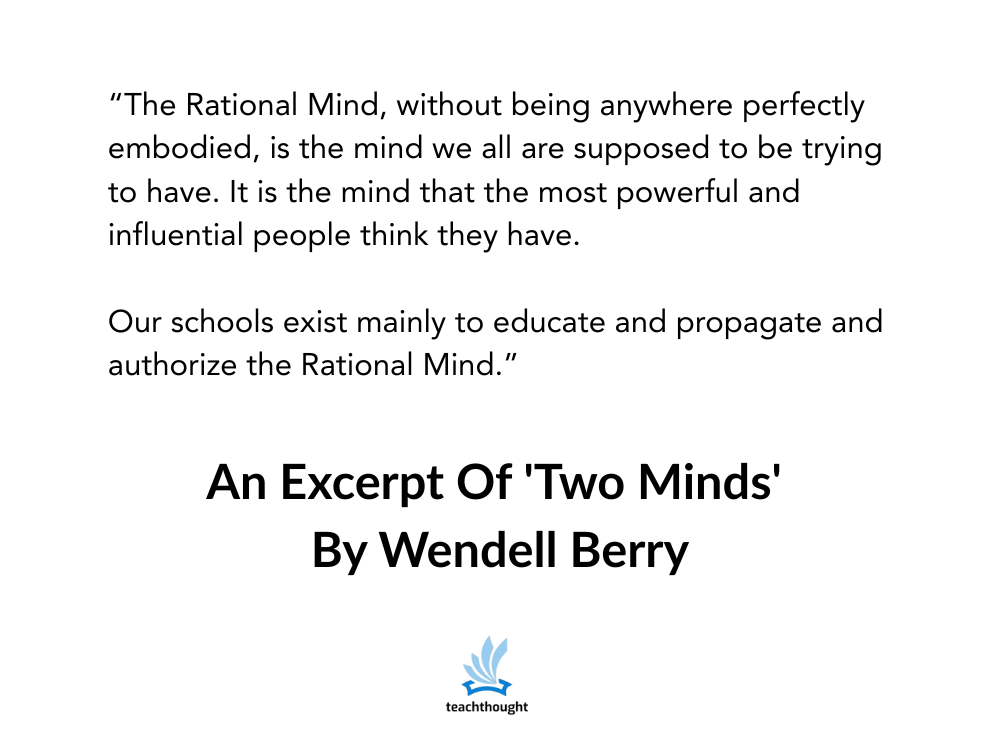
by TeachThought Staff I’ve written many times about Wendell Berry and the effect he has had on me professionally and personally. Preparing Students For Good Work Wendell Berry and the Loss of the University The Peace of Wild Things by Wendell Berry The Want Of Peace The Objective by Wendell…
-
by Terry Heick In our recent post, Education’s Curious Fascination With Uniformity, reader James Foss left a useful comment that had within it an interesting concept–the “purpose of knowledge.” “Is it the standards that dictate curriculum or assessment practices that dictate pedagogy? It is possible the current standardized model might…
-

Originally published in 2012 Like thinking, reading in the 21st century is different than in centuries past, endlessly linked in an increasingly visible web of physical and digital media forms. So in this context of media abundance, what does the modern, 21st century reader look like? There is an art and…
-
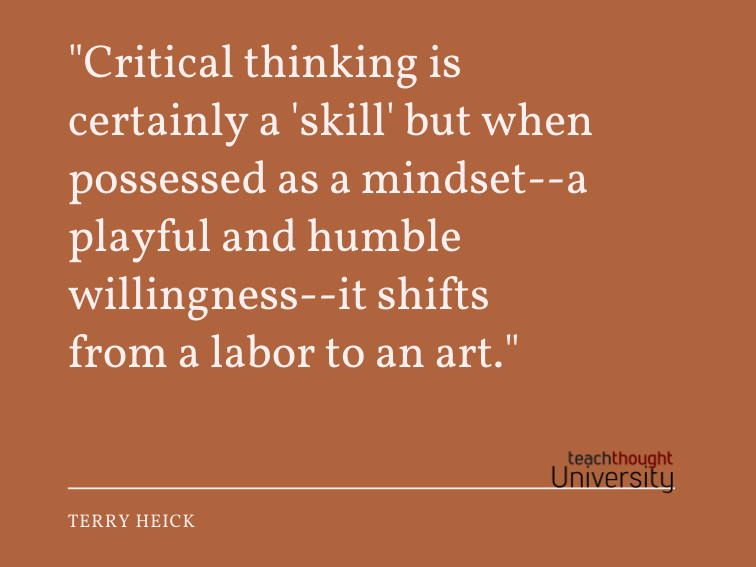
by Terry Heick Every few months, I see an article making the rounds that critical thinking isn’t a skill and therefore can’t be taught. And because it’s also difficult to measure and modern public education is driven by measurement, as an idea it kind of sits in the corner, aloof…
-
“We are what we have done, which includes our promises, includes our hopes, but promises first.” — Wendell Berry Source
-

by Terry Heick What did John Dewey believe? While known by teachers for his work in education (he was a professor of philosophy at Columbia University from 1904 until 1930), he was also a psychologist and philosopher who interested in governing and social improvement and saw public education as a…
-
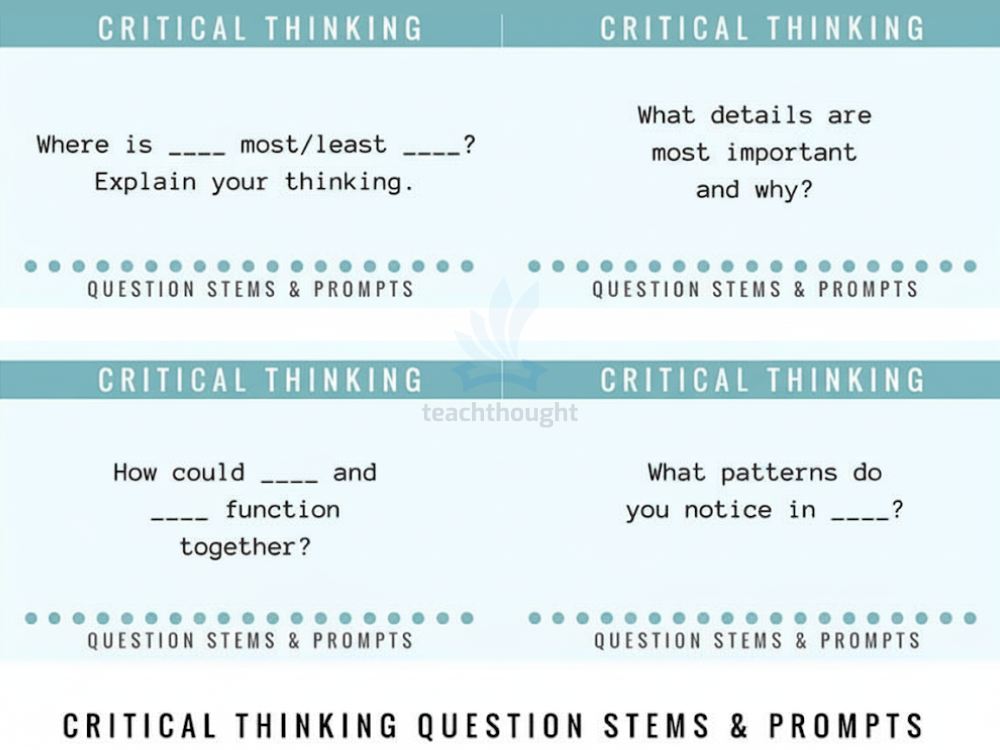
by TeachThought Staff Critical thinking isn’t a skill, nor is it content knowledge or even evidence of understanding. While it involves and requires these ideas, critical thinking is also very much a state of mind — a willingness and tendency to sit with an idea and ‘struggle wonderfully’ with it.…
-
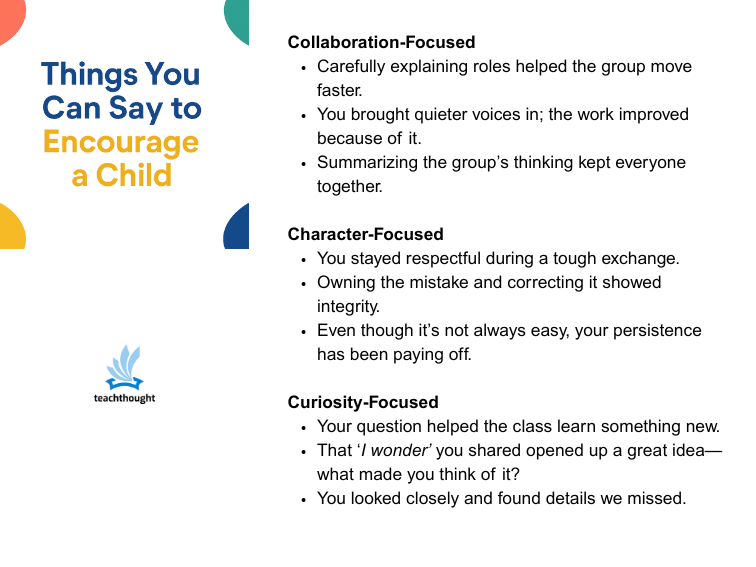
by TeachThought Staff There are many ways to encourage a child, but for students of any age, honest, authentic, and persistent messages from adults that have credibility in their eyes are among the most powerful. The National Center on Quality Teaching and Learning has put together a graphic below–50 Ways To…
-
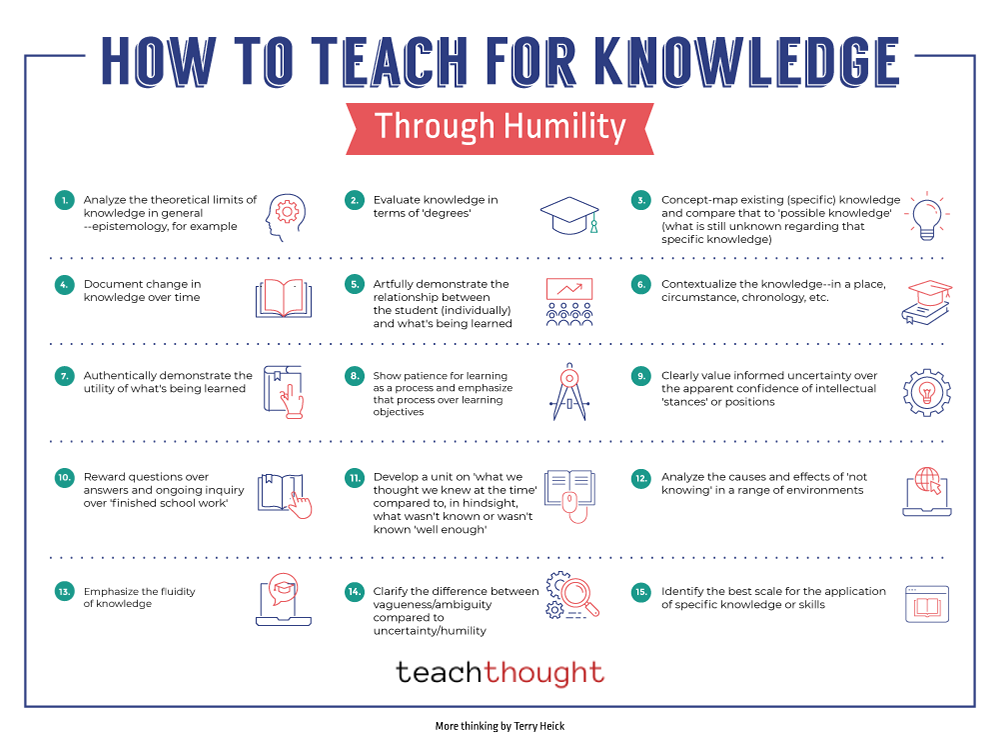
by Terry Heick Humility is an interesting starting point for learning. In an era of media that is digital, social, chopped up, and endlessly recirculated, the challenge is no longer access but the quality of access—and the reflex to then judge uncertainty and “truth.” Discernment. On ‘Knowing’ There is a…
-
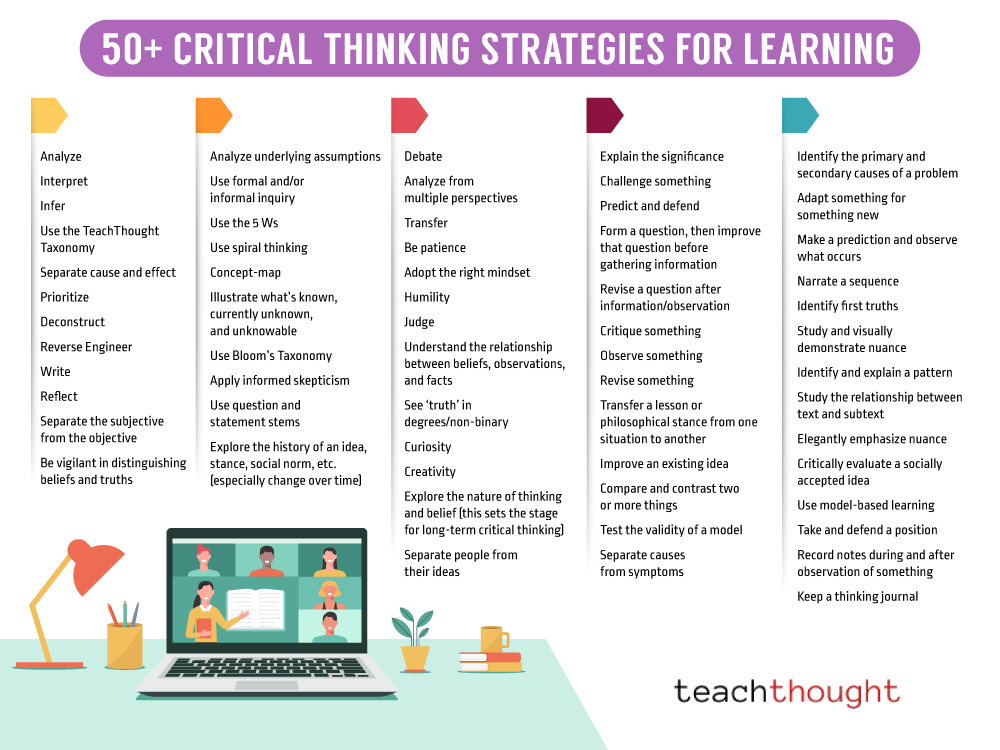
A critical thinking strategy is simply a ‘way’ to encourage or facilitate the cognitive act of thinking critically. Critical thinking is the ongoing application of unbiased, accurate, and ‘good-faith’ analysis, interpretation, contextualizing, and synthesizing multiple data sources and cognitive perspectives in pursuit of understanding. What are the 7 critical thinking…
-
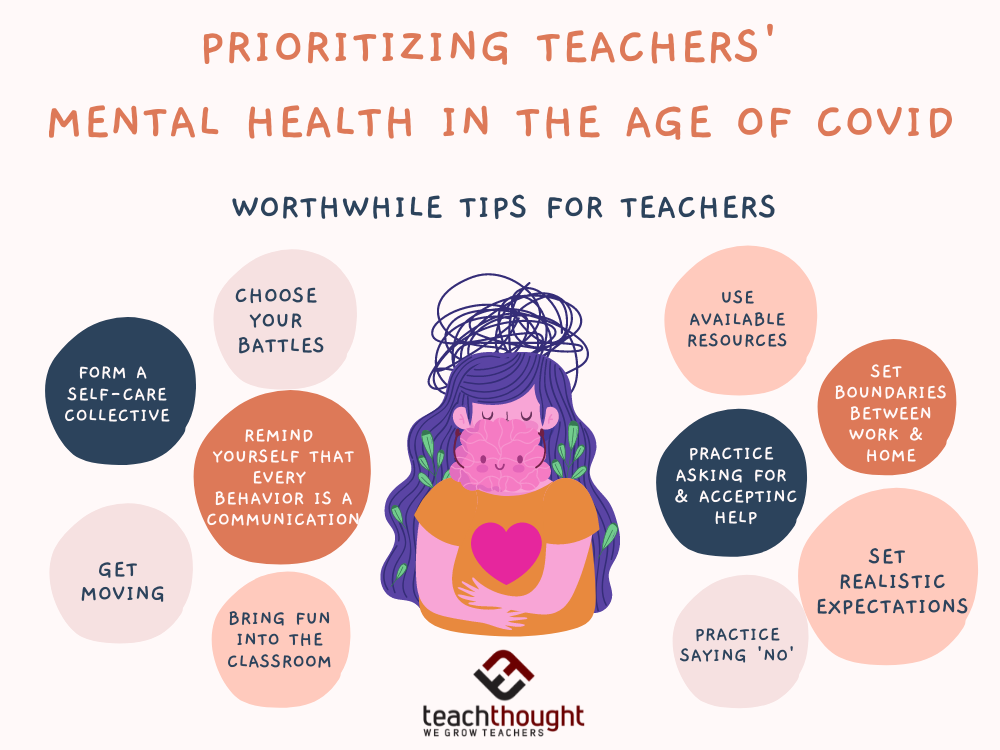
See also The Real You Is All Of Us In the last ten years, too many teachers have left the teaching profession altogether because they feel burned out, unsupported, or unsafe. Any reassurance provided by empty platitudes like, “We’re all in this together” and trivial ‘rewards’ such as denim pants…
-
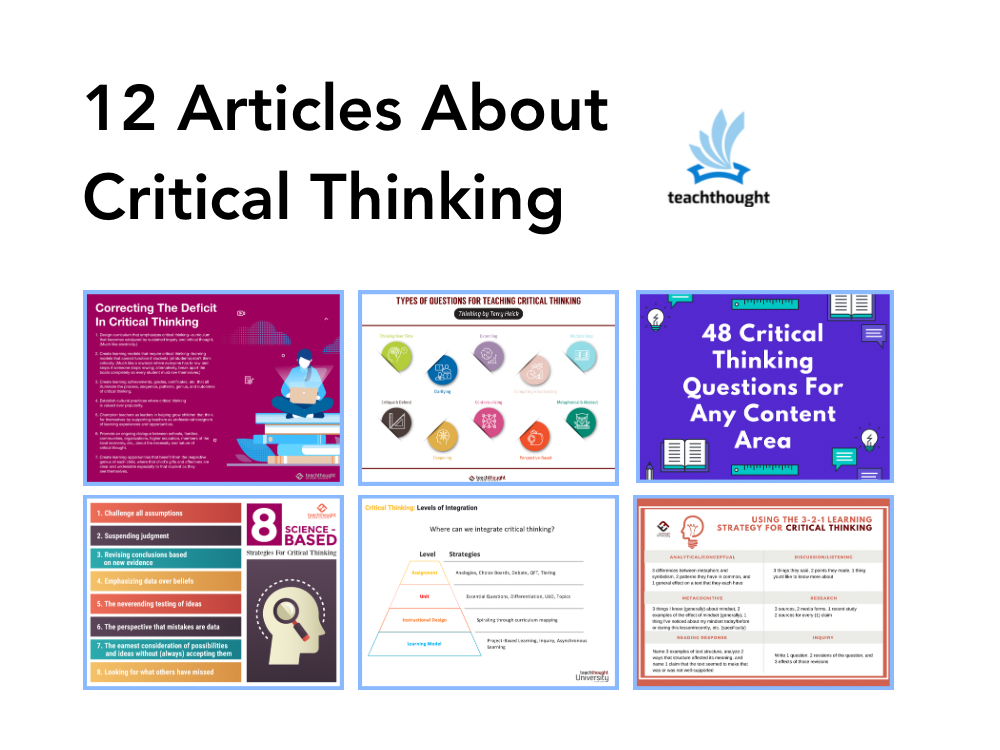
12 Articles About Critical Thinking In The Classroom by TeachThought Staff Critical thinking remains one of the most discussed—and least clearly defined—ideas in education. It’s often treated as a skill, a habit, or a process, depending on the context, but at its core, it’s about how we make sense of…
-
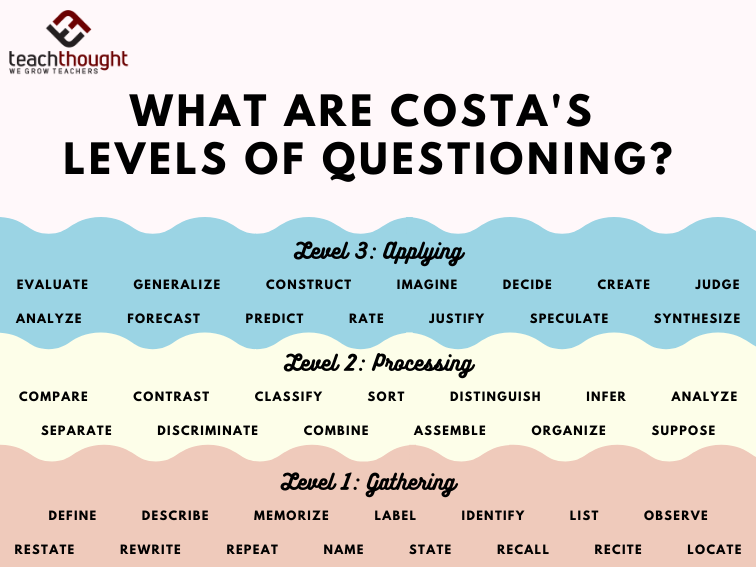
Costa’s Levels of Questioning — designed by educational researcher Art Costa — feature three tiers of questioning designed to promote higher-level thinking and inquiry. Similar to Bloom’s taxonomy, Costa’s lower level prompts students to use more basic faculties; as students move up in levels, the questions prompt them to use…
-
contributed by Angela Peery Picture a classroom full of youngsters. They could be darling, chubby-cheeked kindergartners or swaggering, confident high school seniors – or anything in between. Can you see them? Now, picture this class engrossed in reading. What does being engrossed in reading look like? What does it sound…
-
Knowledge is limited. Knowledge deficits are unlimited. Knowing something–all of the things you don’t know collectively is a form of knowledge. There are many forms of knowledge–let’s think of knowledge in terms of physical weights, for now. Vague awareness is a ‘light’ form of knowledge: low weight and intensity and…
-
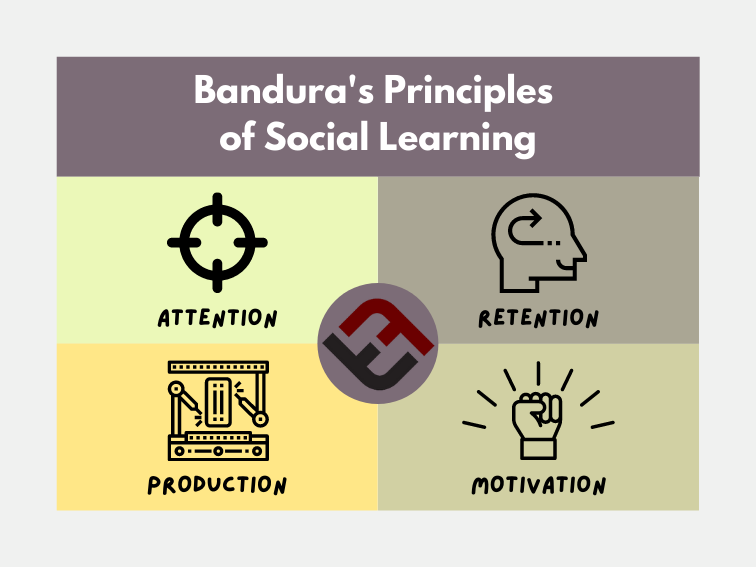
0 “Self-belief does not necessarily ensure success, but self-disbelief assuredly spawns failure.” (Albert Bandura) Those who are new to social learning theory might not make the immediate connection to an individual’s beliefs about their own abilities; however, self-efficacy is a core tenet of Albert Bandura’s social learning theory. In…
-
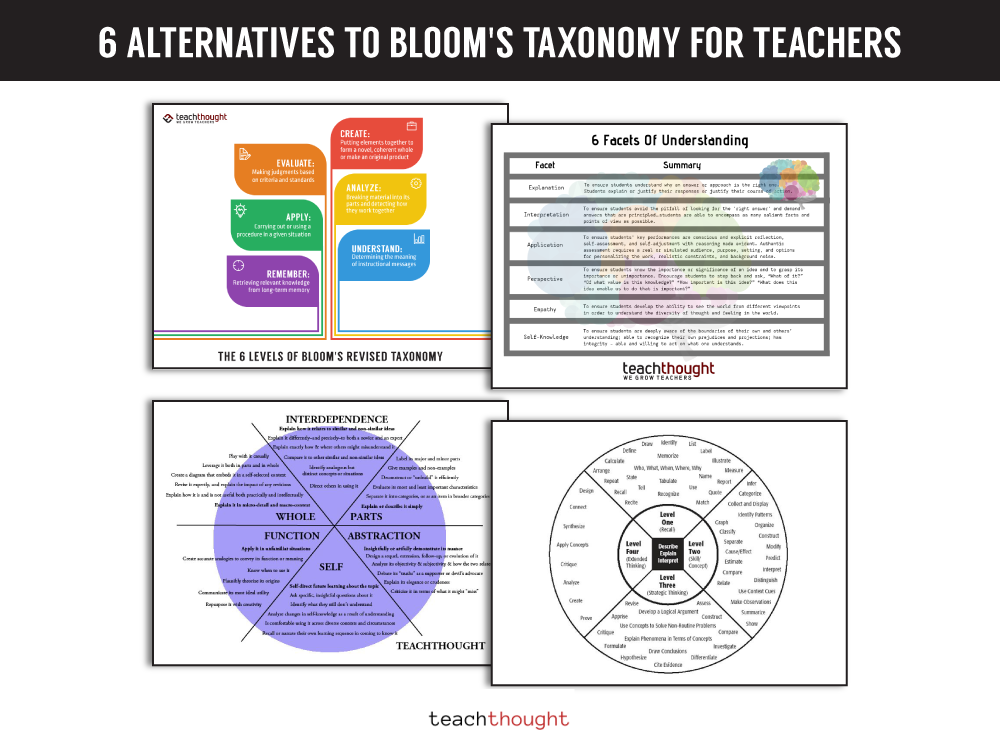
1 by TeachThought Staff At the end of the day, teaching is about learning and learning is about understanding. And as technology evolves to empower more diverse and flexible assessments forms, constantly improving our sense of what understanding looks like–during mobile learning, during project-based learning, and in a flipped classroom–can…
-

Educators and students at all levels are using design thinking to create solutions for real-world problems. Whether you’re new to the concept or looking for fresh ideas, this updated and curated list features high-quality resources that are free, low-cost, or easily accessible to help you get started today. Essential Toolkits…
-

by Terry Heick The influence of Berry on my life–and thus inseparably from my teaching and learning–has been immeasurable. His ideas on scale, limits, accountability, community, and careful thinking have a place in larger conversations about economy, culture, and vocation, if not politics, religion, and anyplace else where common sense…
-
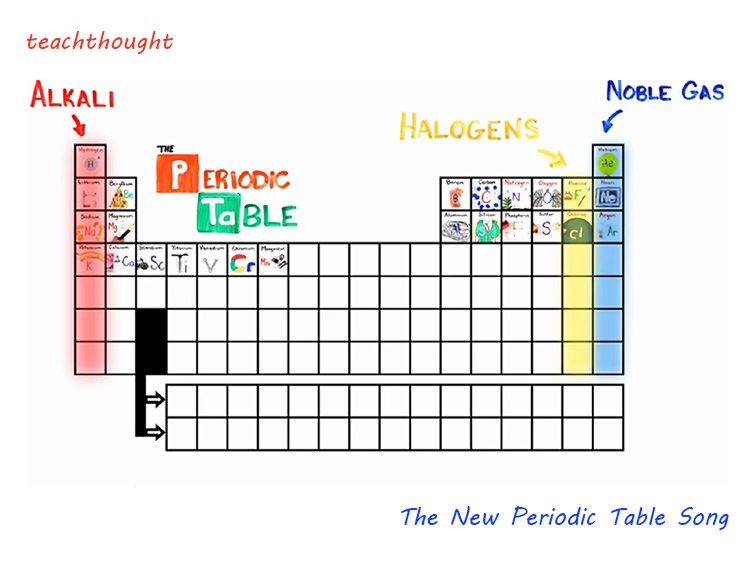
The New Periodic Table Song In Order (To Make You And Your Students Crazy) by TeachThought Staff There once was periodic table song whose frenzied pace and extraordinary organization made it seemingly irreplaceable–a classic among classics. There was no need for another. But in an answer to a question no…
-
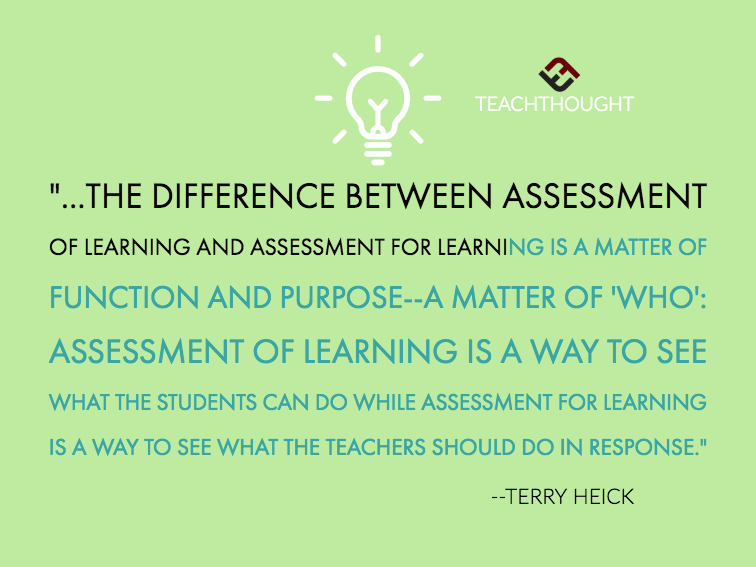
It boils down to purpose. In 50 Ways To Measure Understanding, I talked about the purpose of assessment: Assessment: Of Learning vs. For Learning Assessment is often discussed as though it were a single act—a quiz, test, or score. But its real power comes from clarity of purpose. If you’re…
-

In 2013, I wrote a post for edutopia exploring the difference between students and learners. As ‘learning trends’ become the basis for full-on institutions of learning (see the Avenues: World School and North Star: Self-Directed Learning for Teens for two examples), these kinds of ideas are being field-tested, moving them from wishful…
-
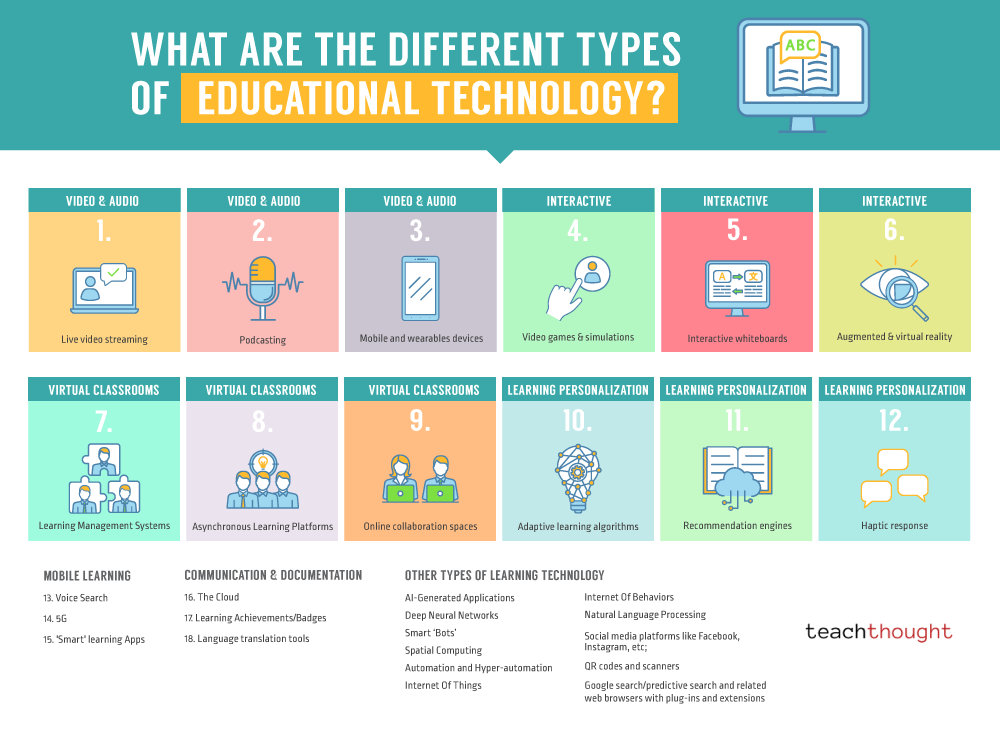
by Terry Heick This is a sponsored post. You can read more about our sponsored content policy here. This is a sponsored post. You can read more about our sponsored content policy here. The goal of this post is simple: To provide examples of learning technology–identifying and clarifying what learning…
-
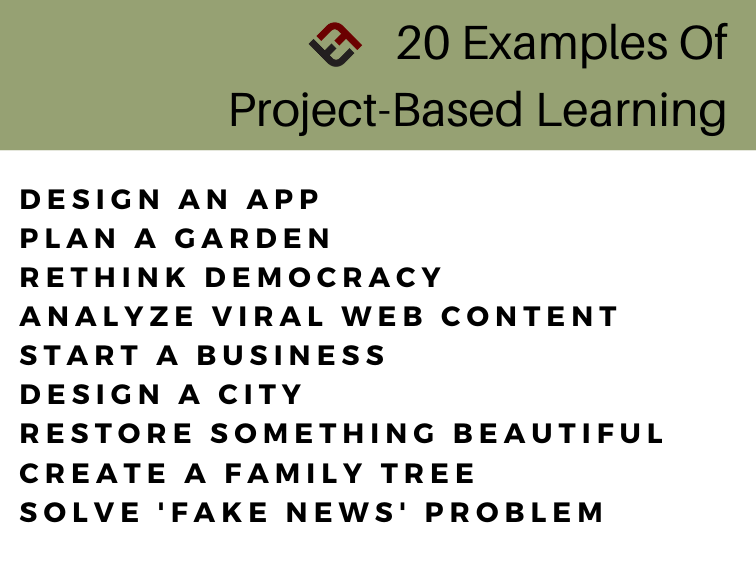
by TeachThought Staff In 13 Brilliant Outcomes Of Project-Based Learning, we gave a quick example of project-based learning to illustrate the relationship between learning objectives and the products and artifacts produced by project-based learning. “As the name implies, project-based learning is simply learning through projects. What is being learned and…
-

Beyond the Hype: Practical Big Data for Educators The term ‘big data’ can sound abstract, but in education, its power lies in revealing specific patterns that genuinely impact teaching and learning. For educators and EdTech professionals, grasping these concrete applications, not vague promises, is crucial. The education sector’s embrace of…
-
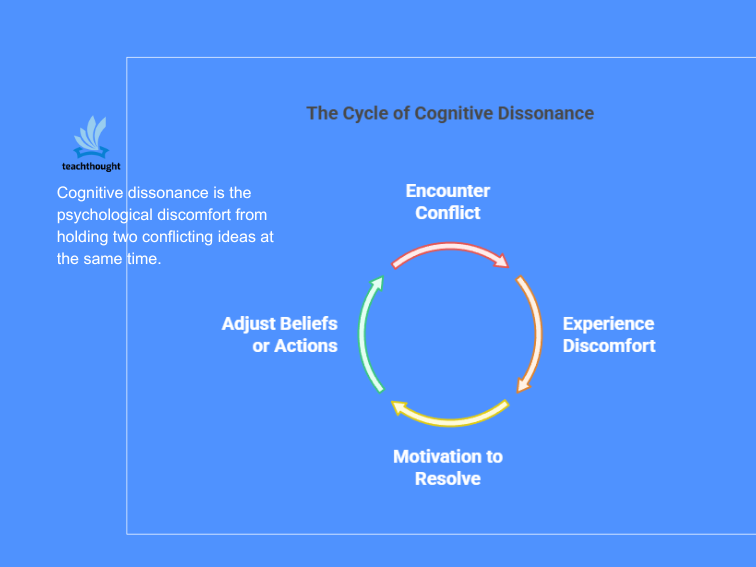
What Is Cognitive Dissonance? A Definition For Teaching Understanding Cognitive Dissonance: A Psychological Framework for Growth and Learning As human beings, we strive for consistency–and alignment between their thoughts, beliefs, and actions. When an inconsistency arises—when beliefs and behaviors clash—it creates a sense of discomfort or tension known as…
-
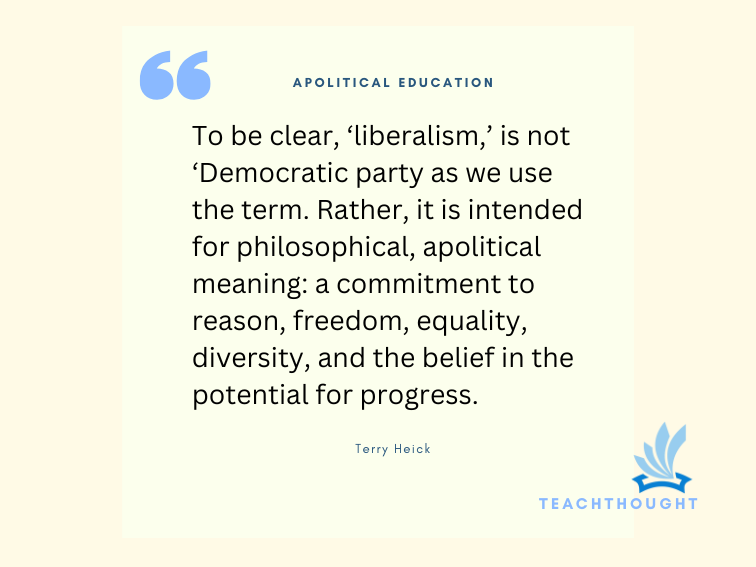
Standing for Critical Thinking and Progress by Terrell Heick At TeachThought, we have always focused on promoting critical thinking cross for use in ‘human’ applications–namely, people (i.e., education stakeholders) and places (i.e., communities). Our mission has been apolitical by design—centered on improving thought, education, and human potential without aligning with…
-
by Terry Heick With so much else to do and a subsequent loss of academic structure, most research shows children read less in the summer. How much less depends (you’ll read that word a lot in this post) on age, income level, geographical region, and other factors. And how much…
-
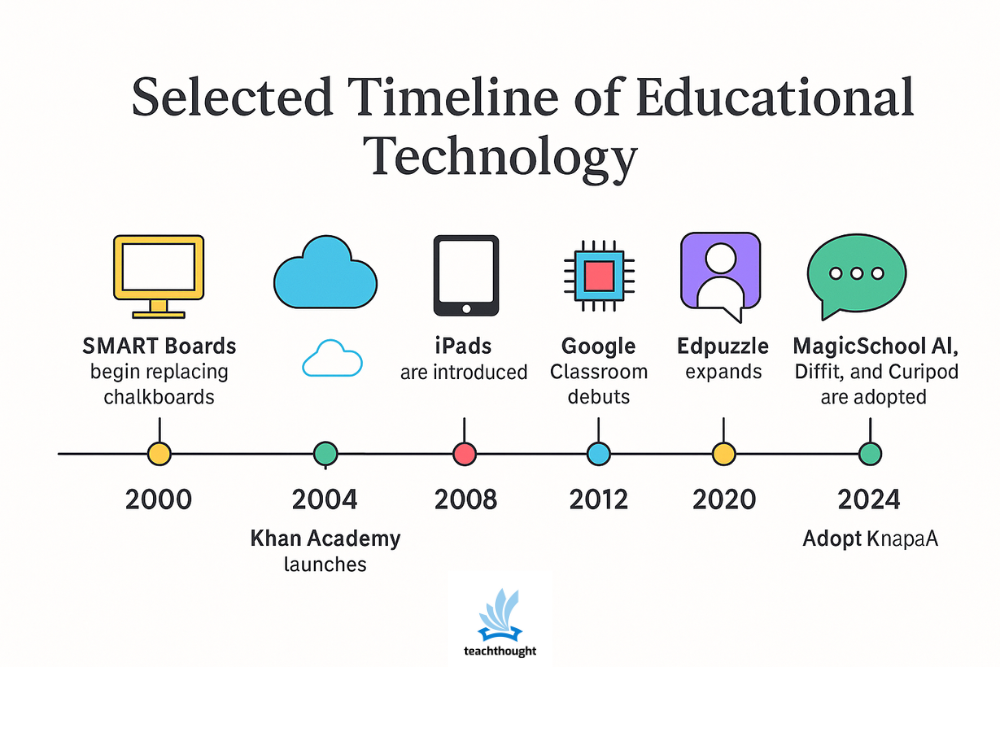
Selected Timeline of Educational Technology (2000–2025) 2000–2003 Digital tools begin to enter classrooms, led by interactive whiteboards and early online platforms like Blackboard. The groundwork is laid for the shift from analog to digital teaching methods. SMART Boards begin replacing chalkboards in U.S. classrooms, offering early digital interactivity. Blackboard expands…
-
Teaching Is Human Work. Systems Aren’t Built for That. Teaching Is Human Work. Systems Aren’t Built for That. Education is structured as a system—standardized, measured, and scaled. But learning doesn’t work that way. And teaching? Teaching is human work—improvised, emotional, and deeply personal. That difference is more than philosophical. It’s…
-
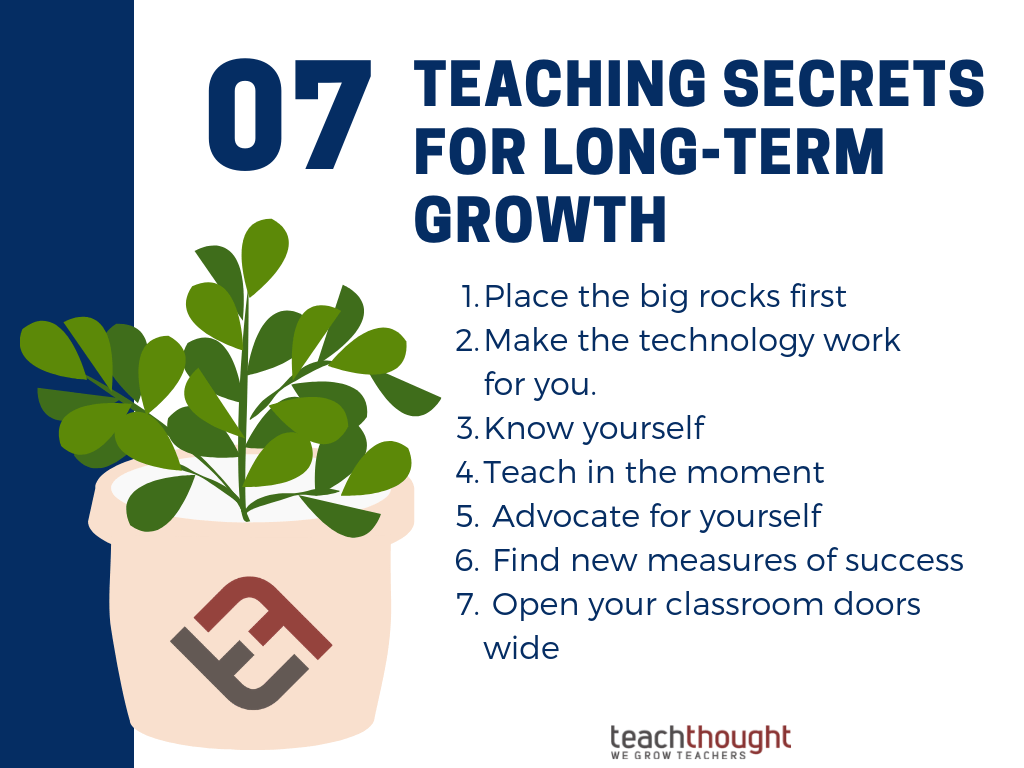
by Terry Heick This post has been updated from a version published in 2013 Good teaching is a major undertaking. Make no mistake–teaching has never been easy. But as we come upon 2014, as a profession teaching is increasingly characterized by its possibility, accountability, and persistent mutation. Which makes it…
-

by Terry Heick Looking for the best source of education research? The one with authentic data, practical studies, and a wealth of participants and possibilities? How about your own classroom? There is, increasingly, pressure to be research-based and data-based. Or ‘grounded in research’ and guided by ‘data-based decision-making. On paper,…
-

by Terry Heick Learning is a culture. It starts there—with the students first as human beings needing to understand their environment. And it ends there—with students using what we give them back at home, in those physical and digital environments. Even the practices that promote or undermine the learning process…
-
Teaching Is Human Work. Systems Aren’t Built for That. Teaching Is Human Work. Systems Aren’t Built for That. Education is structured as a system—standardized, measured, and scaled. But learning doesn’t work that way. And teaching? Teaching is human work—improvised, emotional, and deeply personal. That difference is more than philosophical. It’s…
-
26 Of The Best Free Artificial Intelligence Tools by TeachThought Staff This is obviously a field that changes fast. This list highlights free or freemium tools useful for educators and students in both K–12 and post-secondary contexts. Tools are grouped by function and include a concise explanation of what each…
-
by Terry Heick Understanding where curiosity comes from is the holy grail of education. Education, of course, is different than learning but both depend on curiosity. Education implies a formal, systematic, and strategic intent to cause learning. In this case, content to be learned is identified, learning experiences are planned,…
-
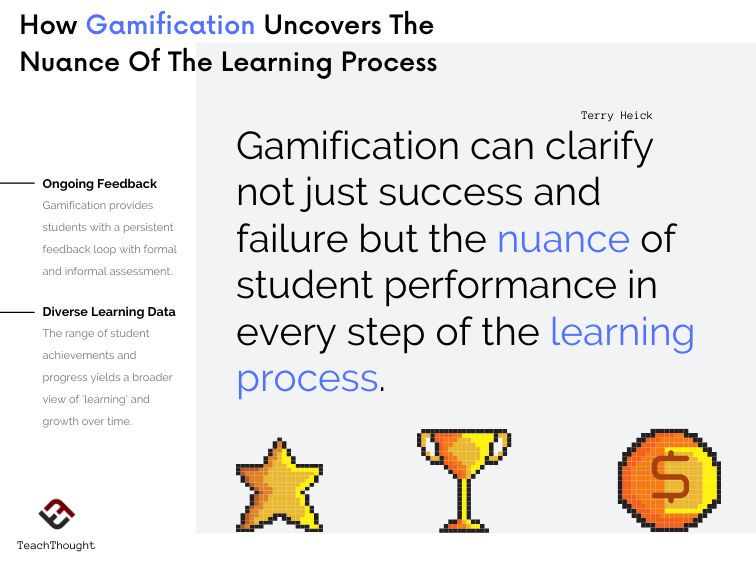
by Terry Heick This article was originally written in 2011 and most recently updated in 2025 Gamification is simply the application of game-like mechanics to non-game ‘things.’ The big idea here is to encourage a desired behavior. In this way, ‘gamification’ amounts to installing mechanics or systems that recognize and reward…
-
by Terry Heick In his essay Two Minds, Wendell Berry, unsurprisingly enough, offers up two tones of thought produced by two kinds of ‘mind’—Rational, and Sympathetic. One is driven by logic, deduction, data, and measurement, the other by affection and other wasteful abstractions—instinct, reverence, joy, and faith. These minds struggle for…
-
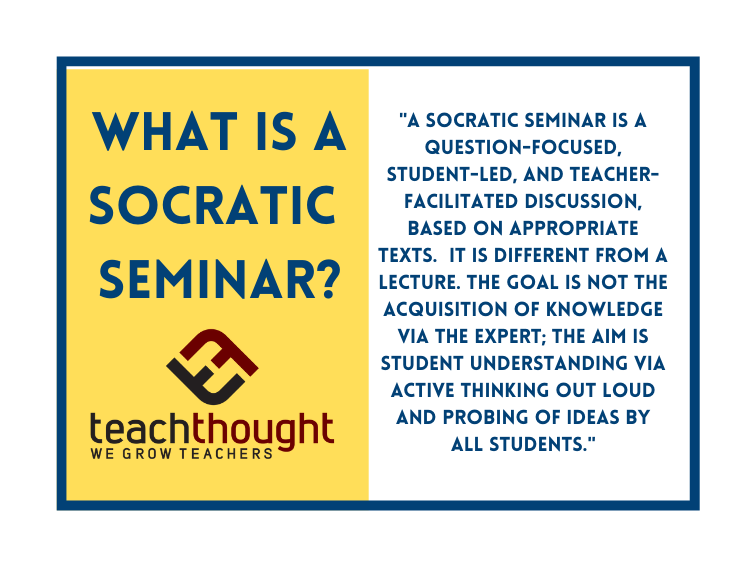
If correctly prepared for, a Socratic seminar can be a powerful catalyst for social learning. Many teachers we know have remarked that individual and collective insights and experiences from Socratic seminars are the moments that most impact students, the moments they remember most poignantly. Simply put, the Socratic method is…
-
1. Brian Johnson: How to teach ‘for’ students, not ‘at’ them Big Idea: Educators should prioritize student engagement by teaching for students, fostering active participation rather than passive reception. In his talk, Brian Johnson emphasizes the importance of shifting from traditional lecture-based teaching to a more interactive approach that centers…
-
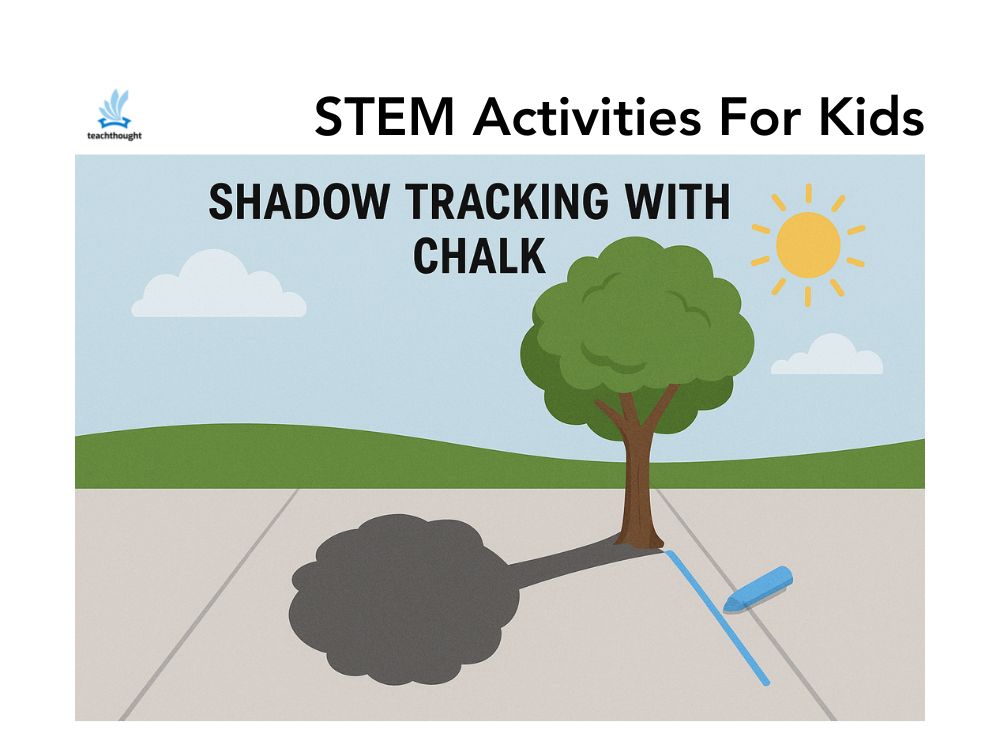
by TeachThought Staff The activities below are designed to be simple, flexible, and fun, making them perfect for learners of all ages, whether you’re a parent, teacher, or an independent learner. Because this is a single post/article post (and not a full lesson plan or curriculum), we’ve focused on quick,…
-
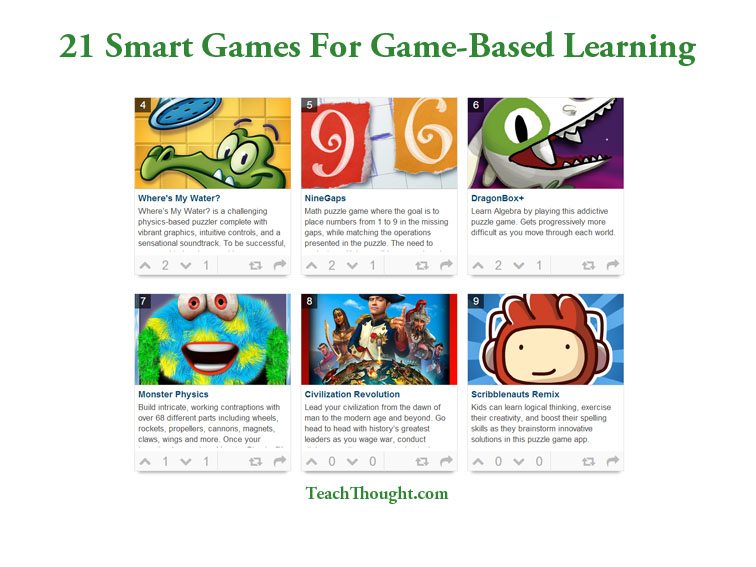
by TeachThought Staff There is a difference between gamification and game-based learning, and this post focuses on the latter. Essentially, game-based learning means to learn through games. Learn what and how–and through what games–is the less straight-forward part. There is seemingly a disconnect between what students learn while playing games…
-
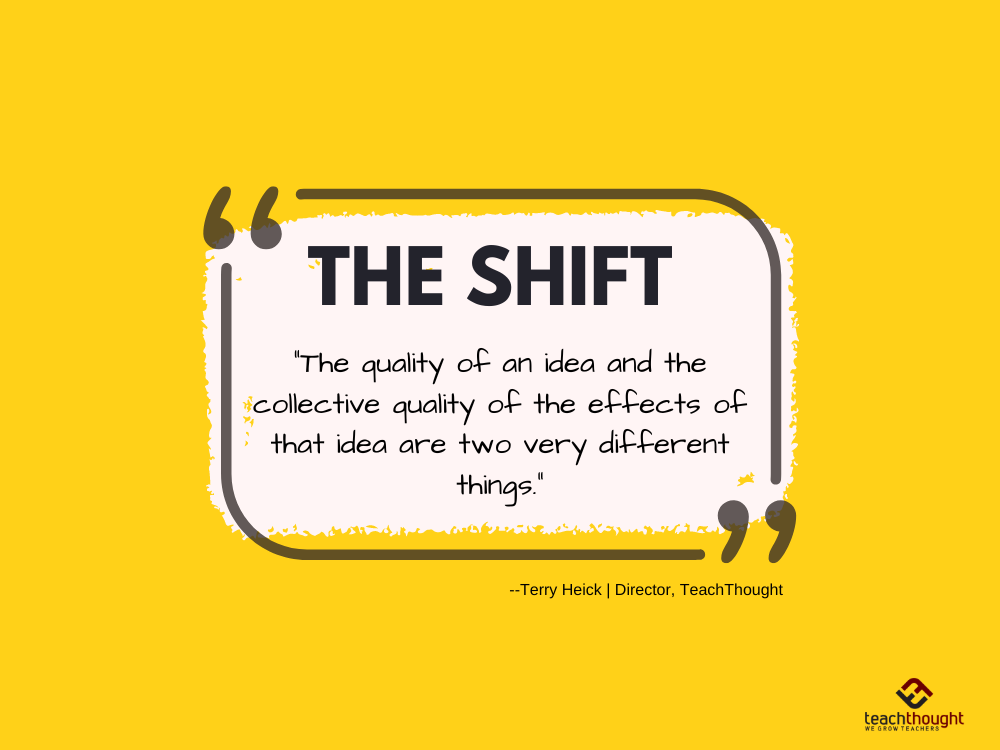
by Terry Heick It’s not the thinking behind an idea that should bother us, but rather the effect of the idea. #edtech. Content-based academic standards. PLCs. Video streaming. Use of data. Mandates to be research-based in our behavior. Remote teaching. Differentiation. Social media in the classroom. None of these ideas…
-

On Student Engagement: How To Be As Interesting As A Video Game Terry Heick Agreeing on how to best establish what a learner understands isn’t simple — if for no other reason then understanding itself isn’t simple. The difference between gamification and game-based learning is important: the former uses encouragement…
-
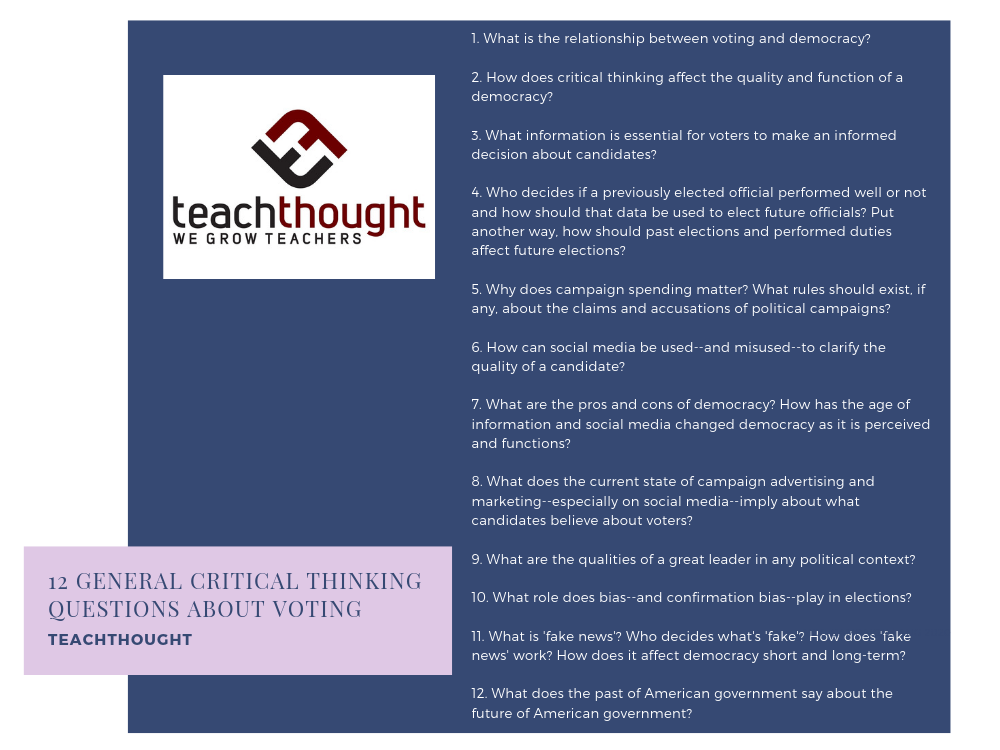
by Terry Heick Note: This has been updates from a 2018 version Just a quick post that’s self-explanatory enough: It’s almost #ElectionDay! Some questions for student critical thinking: What is the relationship between voting and democracy? How does critical thinking affect the quality of a democracy? What information is essential…
-
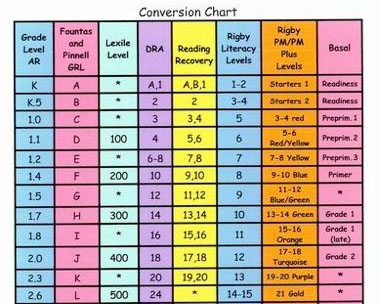
A Conversion Chart For Reading Level Measurement Tools by TeachThought Staff If you’ve used AR (Accelerated Reader) as a reading motivation tool to set goals and track progress, you’re undoubtedly aware of its ability to assess general reading levels as well. The problem is, measuring reading level is really outside…
-
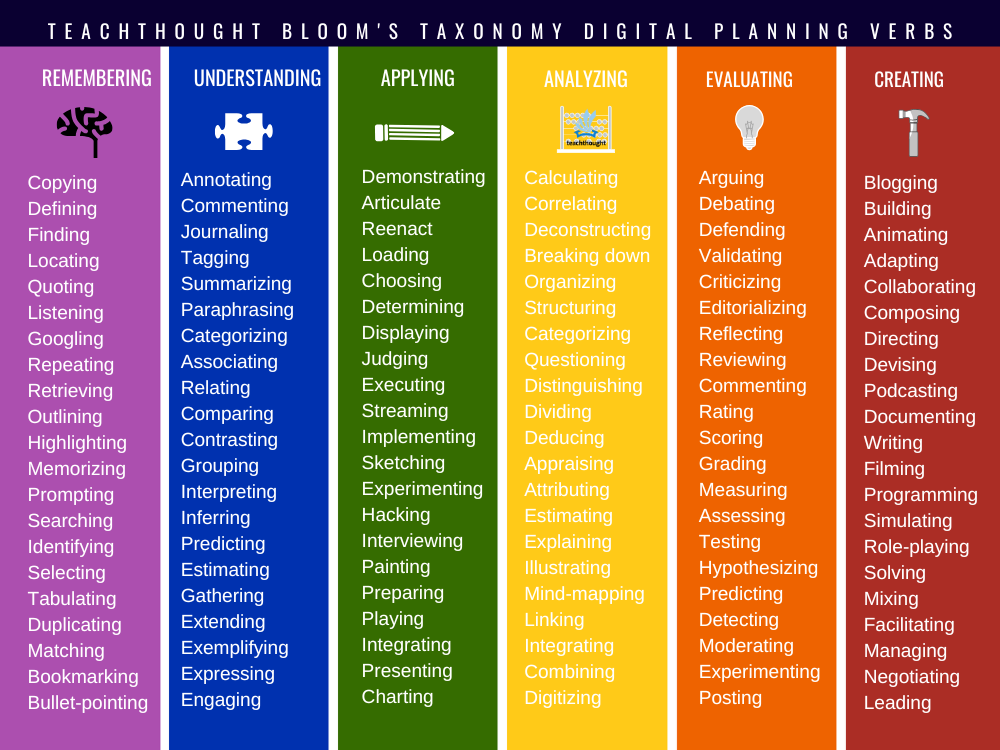
by TeachThought Staff At TeachThought, we’re interested supporters of any learning taxonomy. (We even created our own, the TeachThought Learning Taxonomy.) Learning taxonomies help us think about how learning happens, highlighting that there are many ways to frame thinking. Bloom’s Digital Taxonomy Verbs adapt Bloom’s original cognitive framework for digital learning,…
-
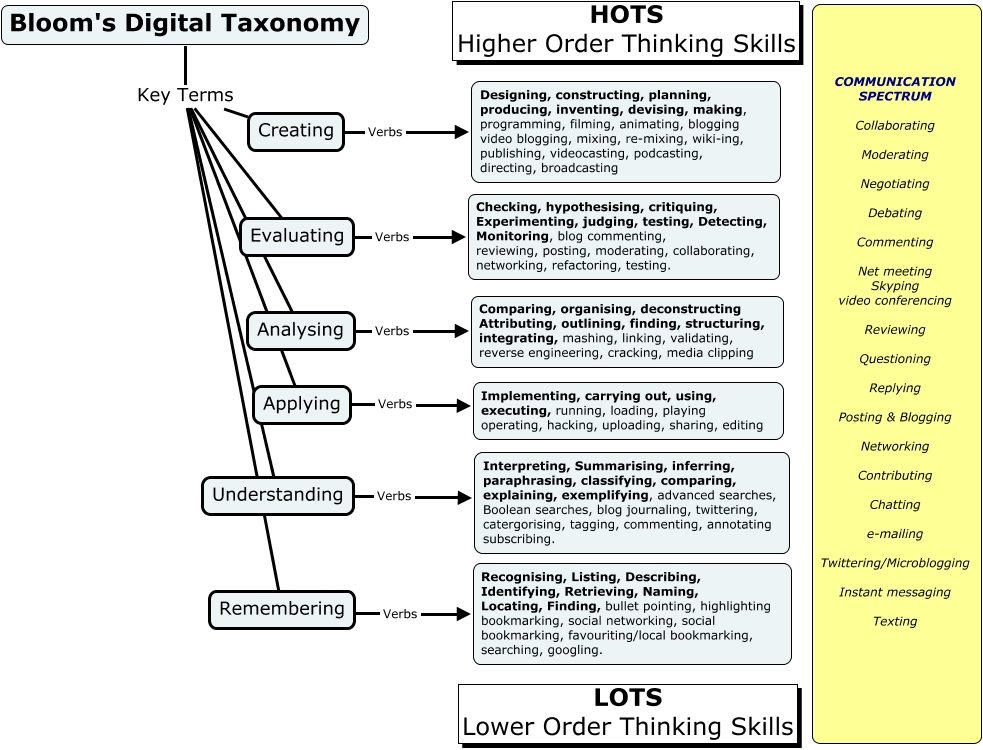
by TeachThought Staff At TeachThought, we’ve described Bloom’s Taxonomy as “a hierarchical ordering of cognitive skills that can, among countless other uses, help teachers teach and students learn.” Whether you’re designing instruction, evaluating an assessment, or observing a classroom, Bloom’s remains a powerful tool for understanding how thinking happens—and how we…
-
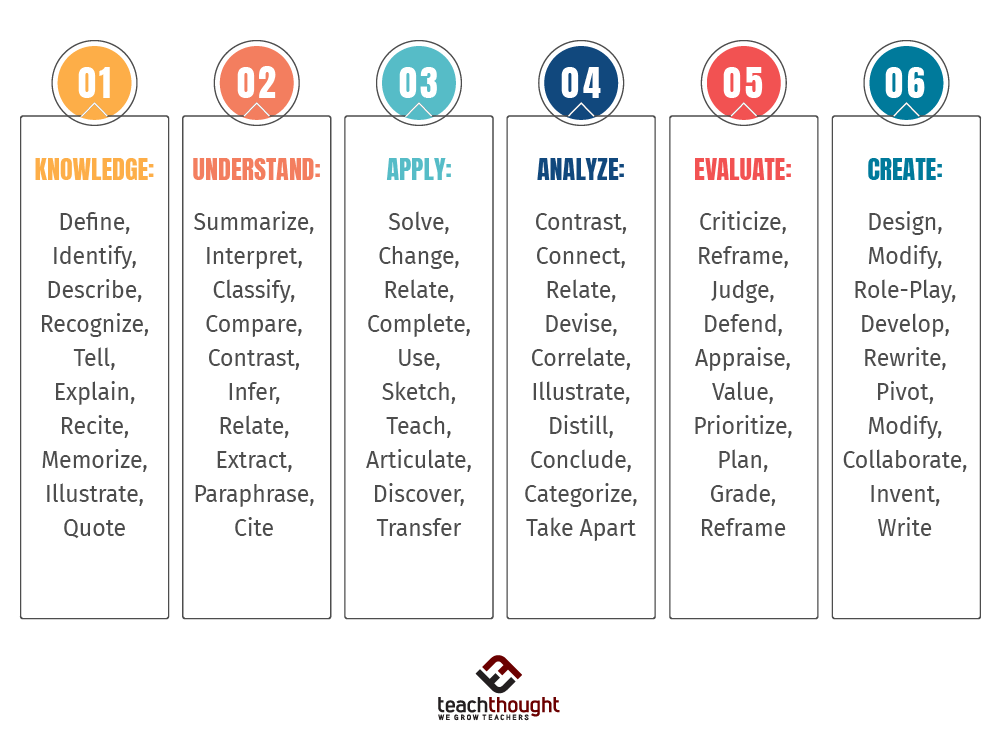
by TeachThought Staff Bloom’s Taxonomy’s verbs–also known as power verbs or thinking verbs–are extraordinarily powerful instructional planning tools. In fact, in addition to concepts like backward design and power standards, they are one of the most useful tools a teacher-as-learning-designer has access to. Why? As research has suggested, they can…
-
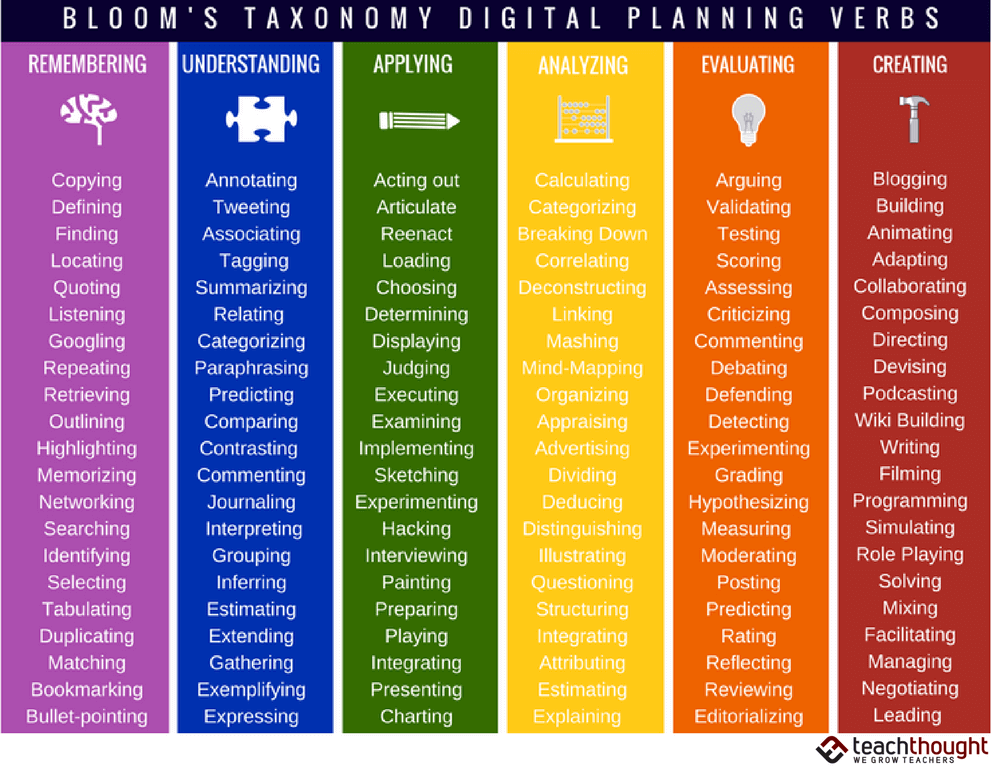
by TeachThought Staff At TeachThought, we’re enthusiastic supporters of any learning taxonomy. (We even created our own, the TeachThought Learning Taxonomy.) Put simply, learning taxonomies help us think about how learning happens. Even if they’re ‘not good’ as we’ve often seen the DOK framework described, they still highlight that there are…
-
by TeachThought Staff At TeachThought, we’ve described Bloom’s Taxonomy as “a hierarchical ordering of cognitive skills that can, among countless other uses, help teachers teach and students learn.” Whether you’re designing instruction, evaluating an assessment, or observing a classroom, Bloom’s remains a powerful tool for understanding how thinking happens—and how we…
-
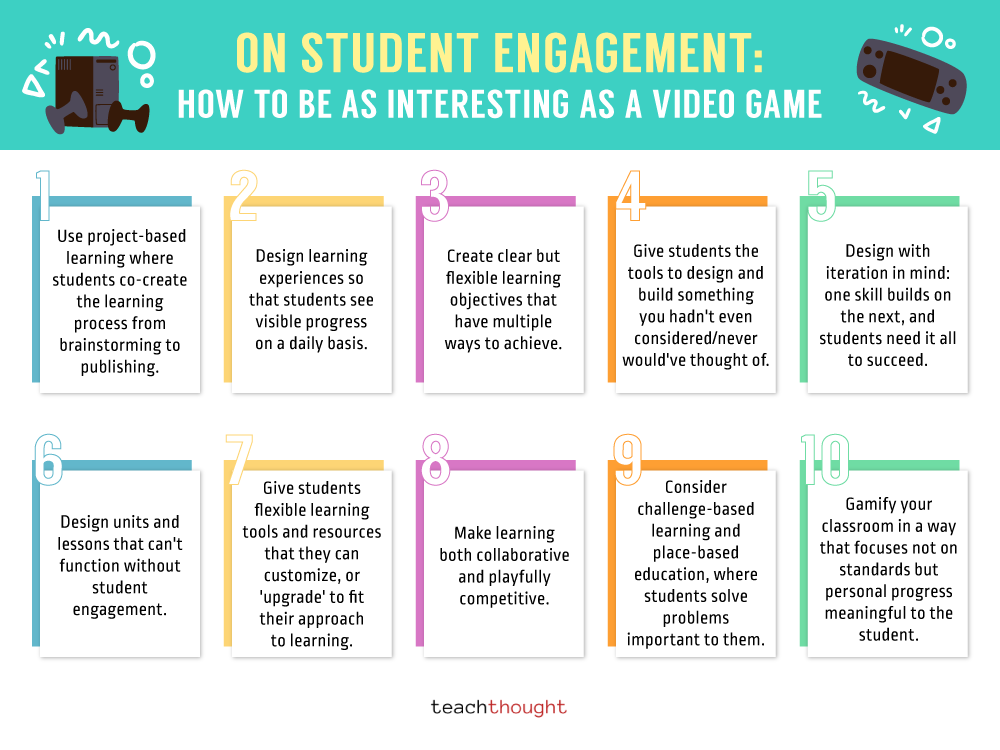
by Terry Heick Agreeing on how to best establish what a learner understands isn’t simple — if for no other reason then understanding itself isn’t simple. The difference between gamification and game-based learning is important: the former uses encouragement mechanics to promote engagement, while the latter uses video games as core sources…
-
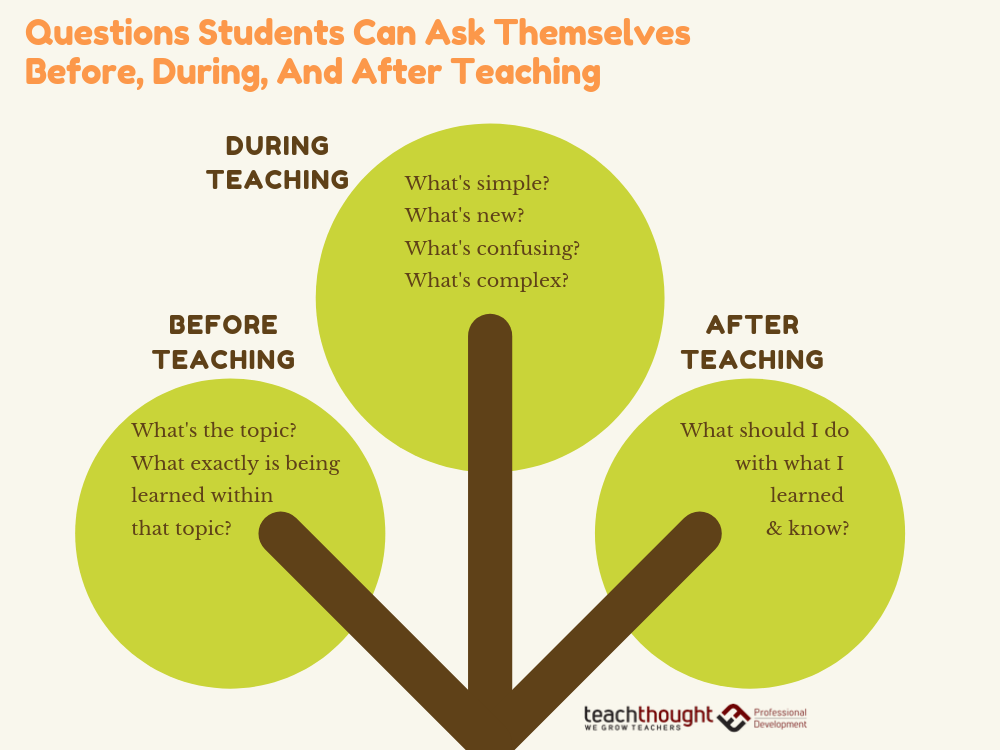
by Terry Heick Are there questions students can ask themselves while you’re teaching? Questions that can guide and support their own thinking and awareness before, during, and after your teaching? Of course, this assumes you’re ‘teaching’ a traditional ‘lesson’ with a learning objective or target. If not, this may not…
-
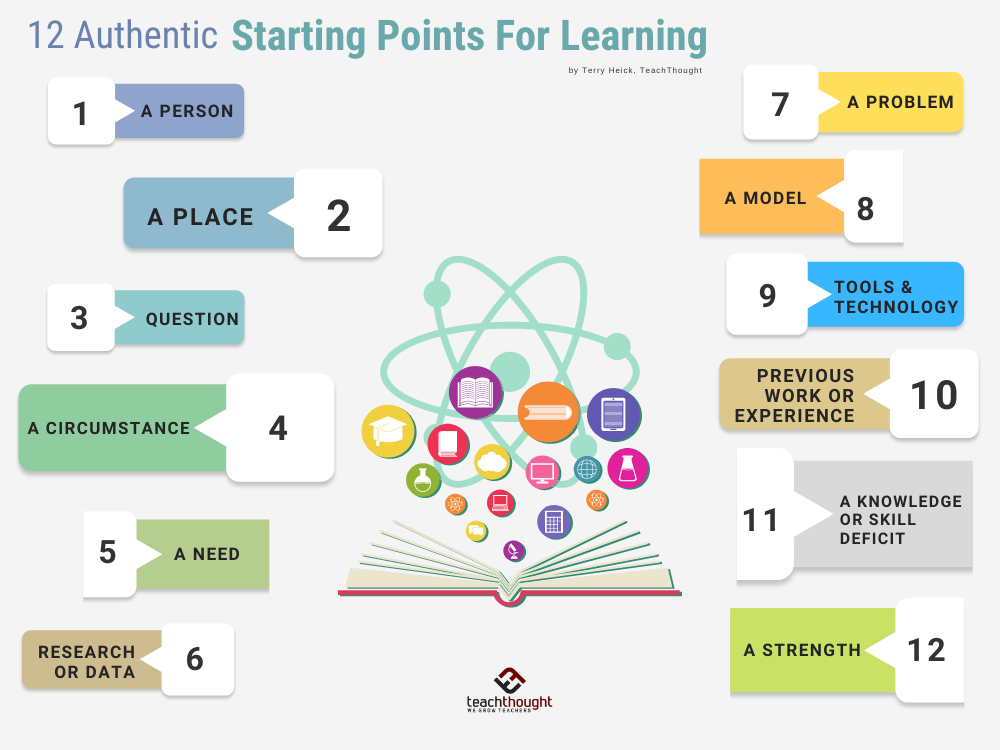
Learning–real, informal, authentic, and lifelong learning–can ‘begin’ with just about anything. In that way, this is obviously not an exhaustive list. Nor am I implying that these are ‘the best’ starting points or that they would be in every case effective in your classroom. There are simply too many variables.…
-
1. Brian Johnson: How to teach ‘for’ students, not ‘at’ them Big Idea: Educators should prioritize student engagement by teaching for students, fostering active participation rather than passive reception. In his talk, Brian Johnson emphasizes the importance of shifting from traditional lecture-based teaching to a more interactive approach that centers…
-
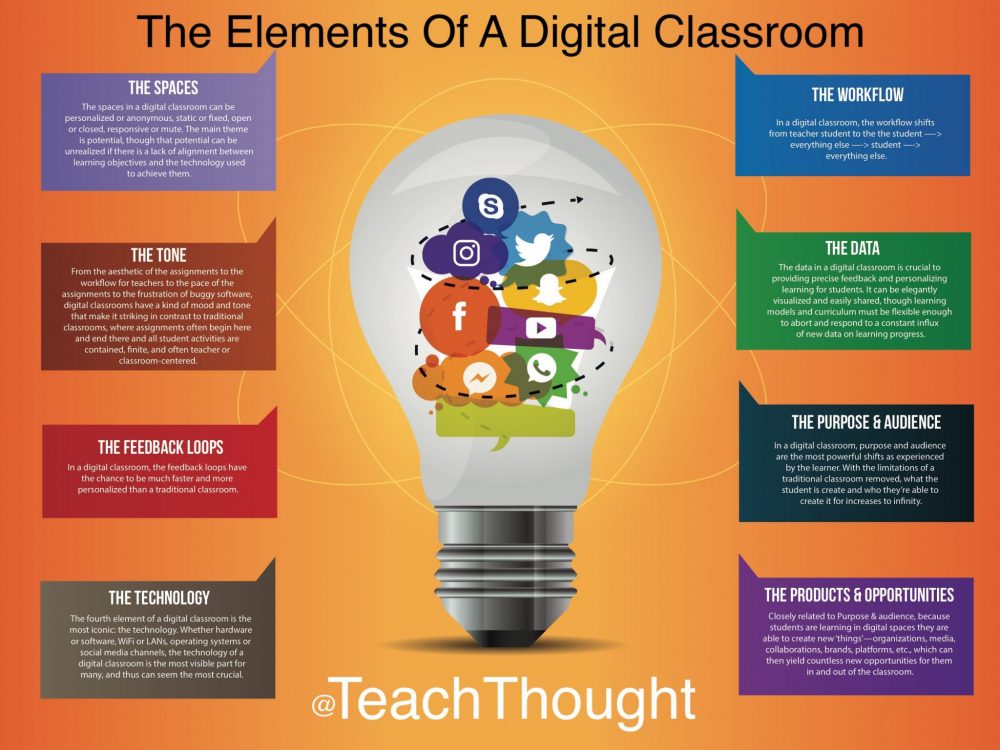
by TeachThought Staff What makes up a classroom? Is it the space? A room, for example? Is it the purpose? Can a regular meeting space in a garden be a ‘horticulture classroom’? Is it the people? Can a video conference with eight people gathered to study chemistry be considered a…
-

by TeachThought Staff In The Difference Between Between Gamification and Game-Based Learning, we learned the difference between the two. “Gamification is first and foremost about encouragement mechanics and the system that promotes them, while game-based learning is first and foremost about the game and its cognitive residue (whether from the…
-
by TeachThought Staff There is a difference between gamification and game-based learning, and this post focuses on the latter. Essentially, game-based learning means to learn through games. Learn what and how–and through what games–is the less straight-forward part. There is seemingly a disconnect between what students learn while playing games…
-
by Terry Heick It’s not the thinking behind an idea that should bother us, but rather the effect of the idea. #edtech. Content-based academic standards. PLCs. Video streaming. Use of data. Mandates to be research-based in our behavior. Remote teaching. Differentiation. Social media in the classroom. None of these ideas…
-
by TeachThought Staff The activities below are designed to be simple, flexible, and fun, making them perfect for learners of all ages, whether you’re a parent, teacher, or an independent learner. Because this is a single post/article post (and not a full lesson plan or curriculum), we’ve focused on quick,…
-
If correctly prepared for, a Socratic seminar can be a powerful catalyst for social learning. Many teachers we know have remarked that individual and collective insights and experiences from Socratic seminars are the moments that most impact students, the moments they remember most poignantly. Simply put, the Socratic method is…
-
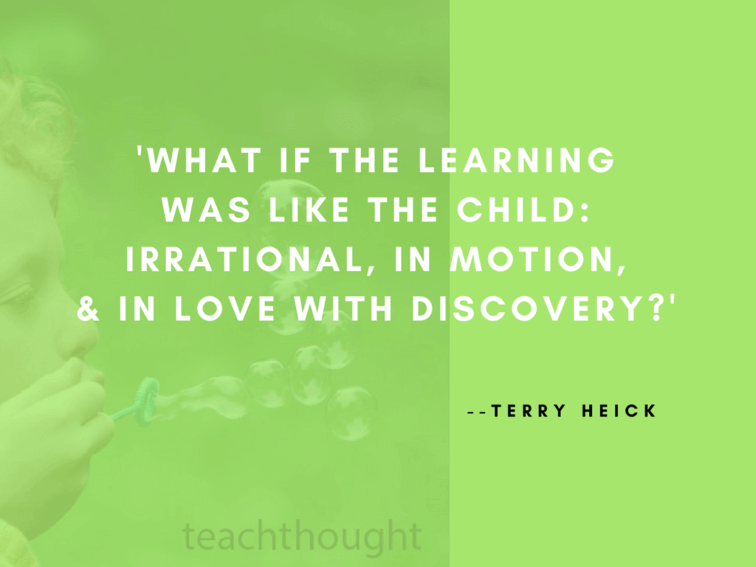
Teach Students To Think Irrationally by Terry Heick Formal learning is a humbling thing. As planners, designers, executors, and general caretakers of public and private education systems, we are tasked with the insurmountable: overcome a child’s natural tendency to play, rebel, and self-direct in hopes of providing them with a…
-
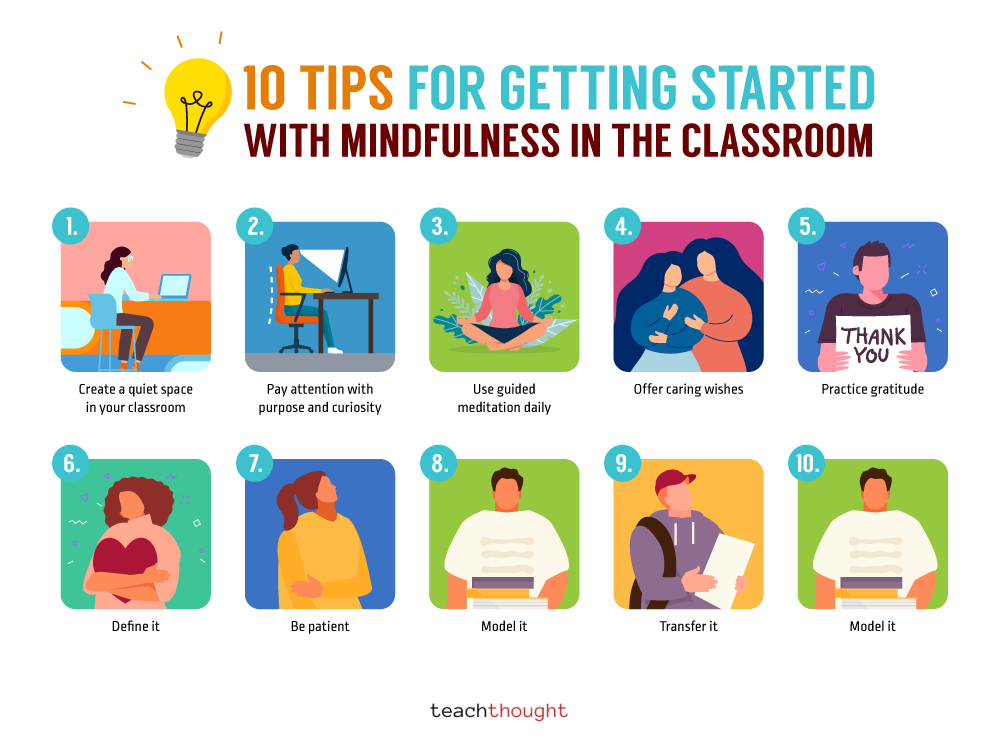
by TeachThought Staff While the scientists at the University of Wisconsin-Madison Center for Investigating Healthy Minds (CIHM) at the Waisman Center aren’t yet ready to issue evidence-based mindfulness curriculum practices, Flook and CIHM outreach specialists Lisa Thomas Prince and Lori Gustafson offer the following tips for families wishing to engage…
-
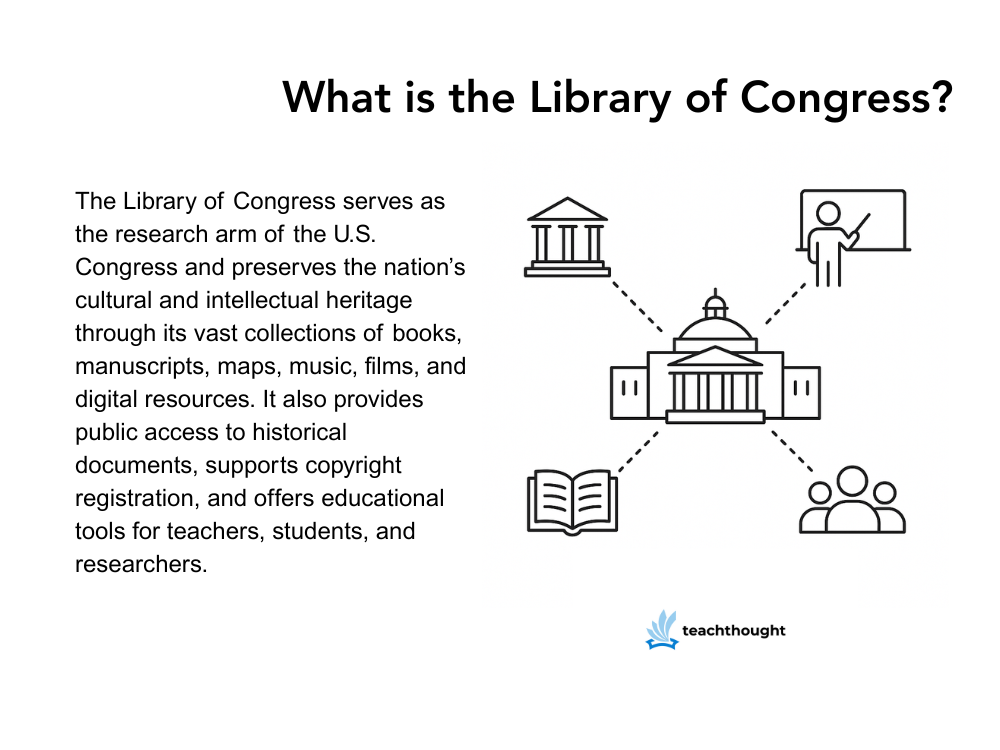
What Is The Library Of Congress? by TeachThought Staff The recent dismissal of Dr. Carla Hayden, the 14th Librarian of Congress, has brought renewed attention to the Library of Congress—but what exactly is the Library of Congress, and why does it matter? The Librarian of Congress leads the institution and…
-
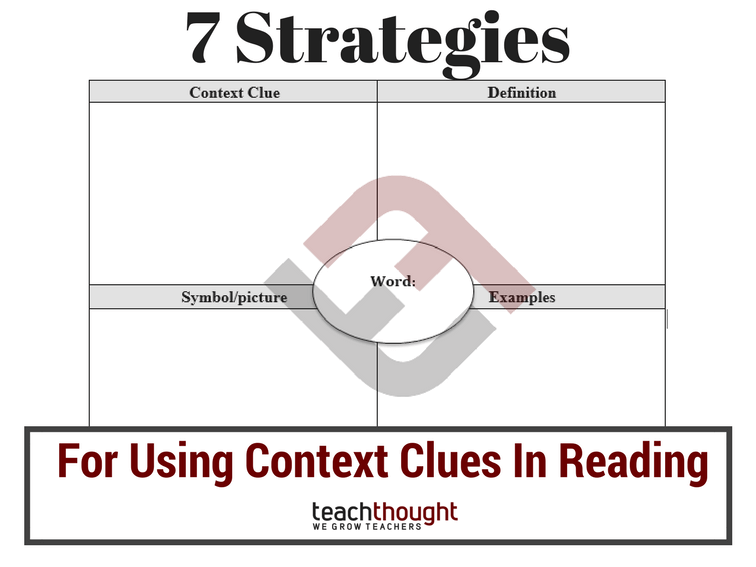
contributed by Kathy Glass We often ask students to use context clues to figure out a word’s meaning. That makes it our job as teachers to explicitly teach how authors use them. In doing so, students gain an inventory of strategies (such as using reading response questions) to unlock the…
-
by TeachThought Staff So you’re considering taking a teaching job? Or at least interviewing? What should you be asking to make sure it’s a good fit for both you and the school? Understanding The Point Of The A Teacher Job Interview First, understand that you are interviewing the school and…
-
12 Articles About Critical Thinking In The Classroom by TeachThought Staff Critical thinking remains one of the most discussed—and least clearly defined—ideas in education. It’s often treated as a skill, a habit, or a process, depending on the context, but at its core, it’s about how we make sense of…
-
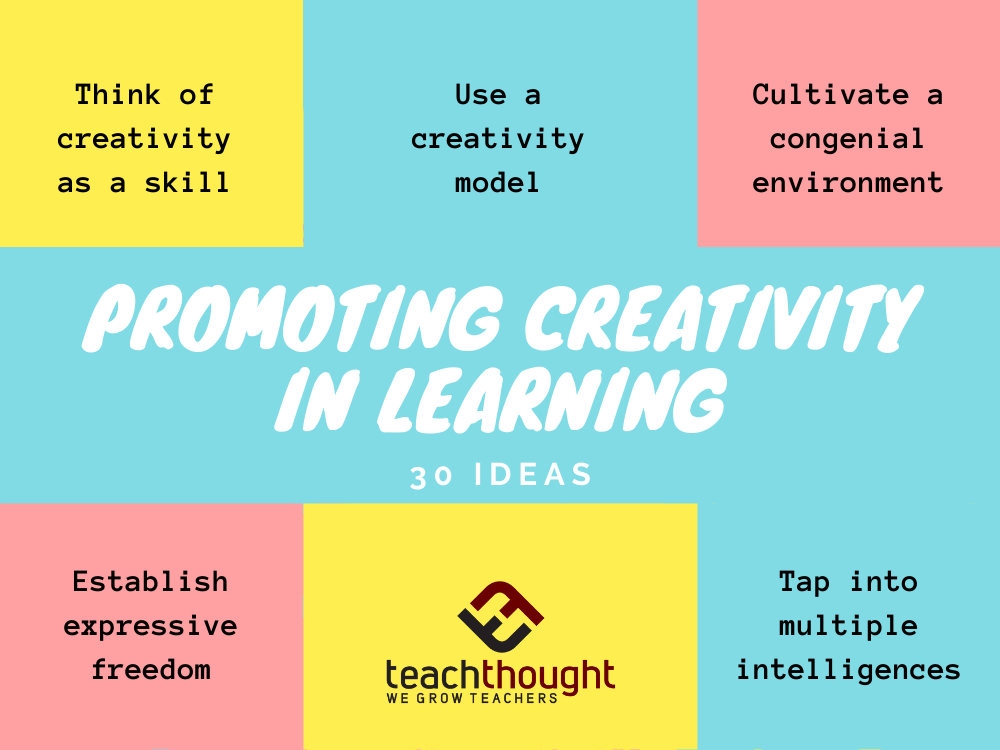
The concept of teaching creativity has been around for quite some time. See also What Is Divergent Thinking? Much of the blame for a lack of creativity, and therefore innovation, can be traced to our traditional educational systems. It relies on teaching to the correct answer. An innovative thinking model…
-

1. Master the Search Bar: Your Time-Saving Powerhouse Don’t waste time scrolling through endless files. Google Drive’s search bar is surprisingly intelligent. Use keywords, file types (e.g., “presentation,” “essay,” “PDF”), dates, or even specific phrases within documents to pinpoint what you need instantly. You can also use advanced search operators…
-
by TeachThought Staff Creativity is often associated with elementary students who are encouraged to draw or color to self-express. According to a study published in the Thinking Skills and Creativity journal, students who regularly engage in creative tasks show statistically significant gains in problem-solving and reflective judgment (Beghetto & Kaufman,…
-
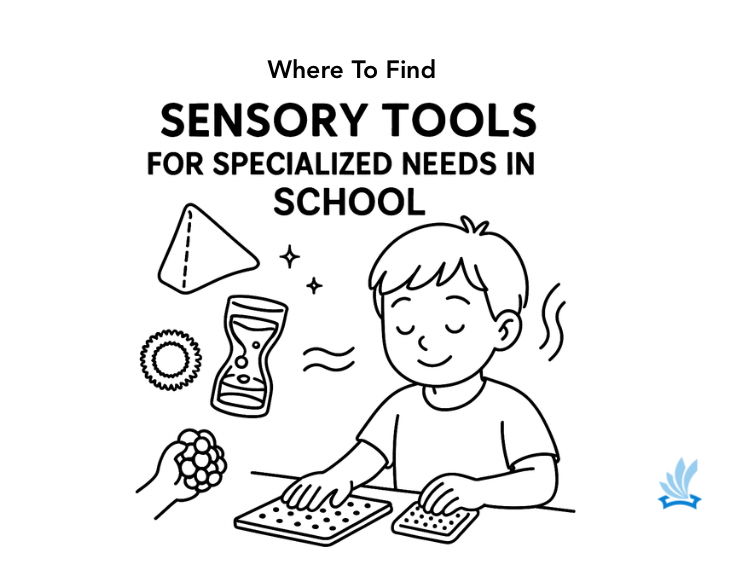
In a world full of stimuli, sensory rooms are becoming an essential tool for schools looking to better support students with sensory sensitivities, autism, ADHD and anxiety. These thoughtfully designed spaces offer a calming refuge, helping students regulate their emotions, focus better in class and engage with learning on their…
-
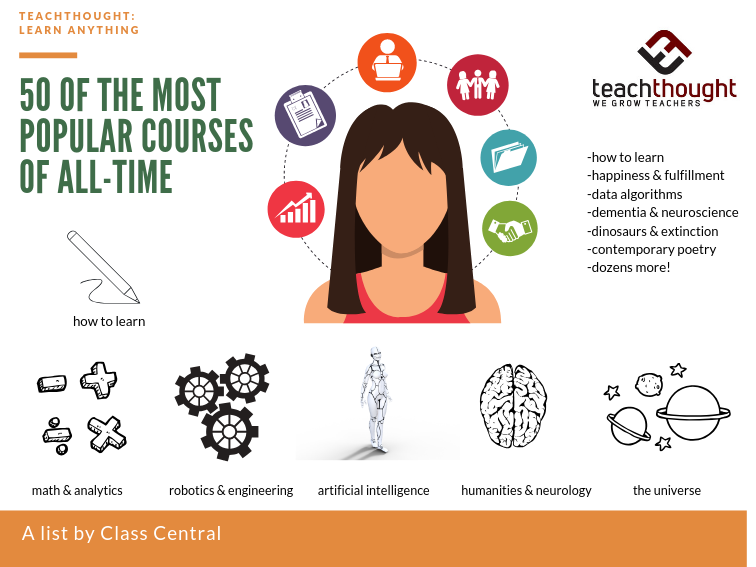
by TeachThought Staff Astronomy: Exploring Time and Space (University of Arizona) Comprehensive introduction to the universe, from planets to galaxies. Covers fundamental concepts of modern astronomy, space exploration, and the tools astronomers use to study cosmic phenomena. Learning How to Learn (McMaster University, UCSD) Teaches powerful mental tools and techniques…
-
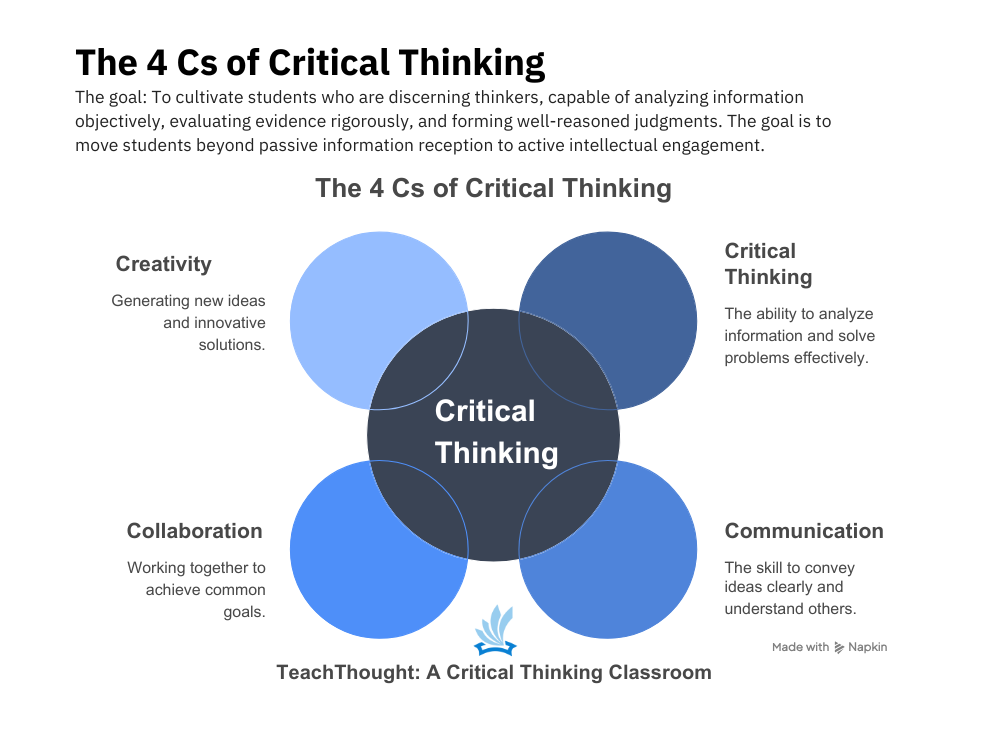
The Foundational 4 Cs of Critical Thinking in K-12 Education by TeachThought Staff What Are The 4 Cs of Critical Thinking? Critical thinking, as a concept and practice, can be framed in various ways. It can be seen, for example, through its function as a social construct, its relationship with…
-
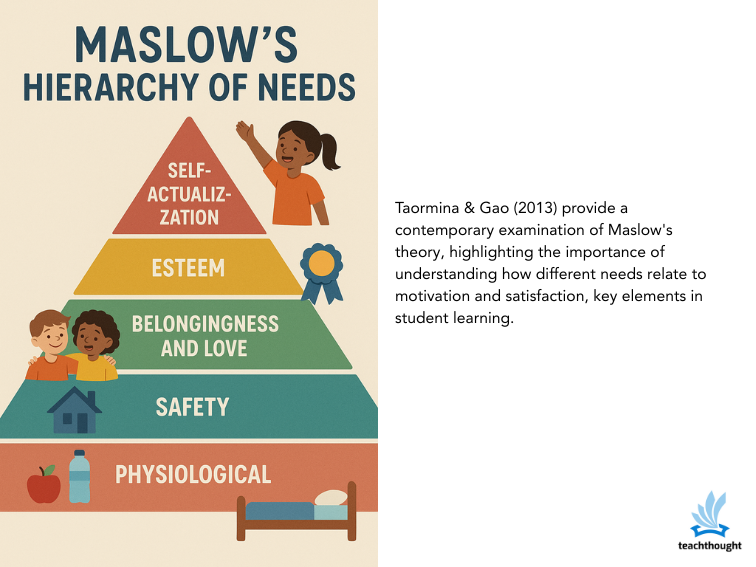
Teaching Strategies For Maslow’s Hierarchy Of Needs by TeachThought Staff Maslow’s Hierarchy of Needs, developed by psychologist Abraham Maslow in 1943, is a foundational theory in psychology that describes the stages of human needs as a pyramid, with the most basic needs at the bottom and more advanced needs at…
-
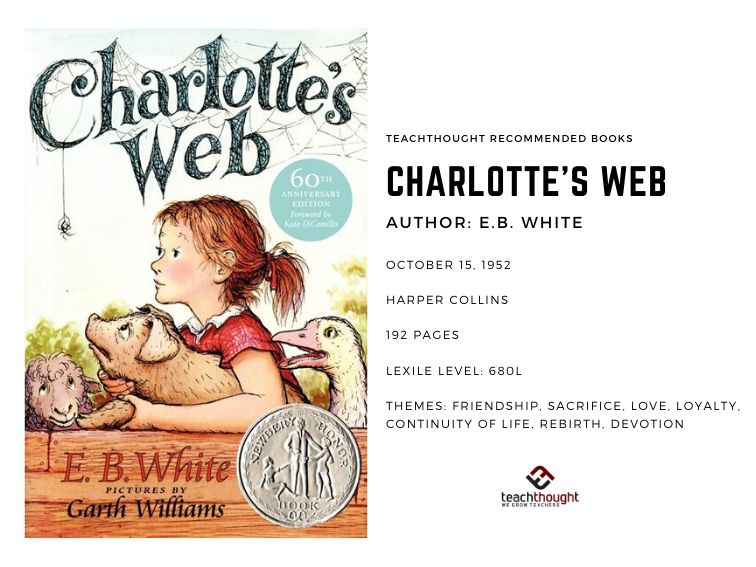
by TeachThought Staff Today’s product Pick Of The Day is a childhood classic on almost every self-respected reading list in the United States (and many beyond): Charlotte’s Web book by E.B. White. The following links are affiliate links–which have zero to do with recommending Charlotte’s Web or any other book…
-
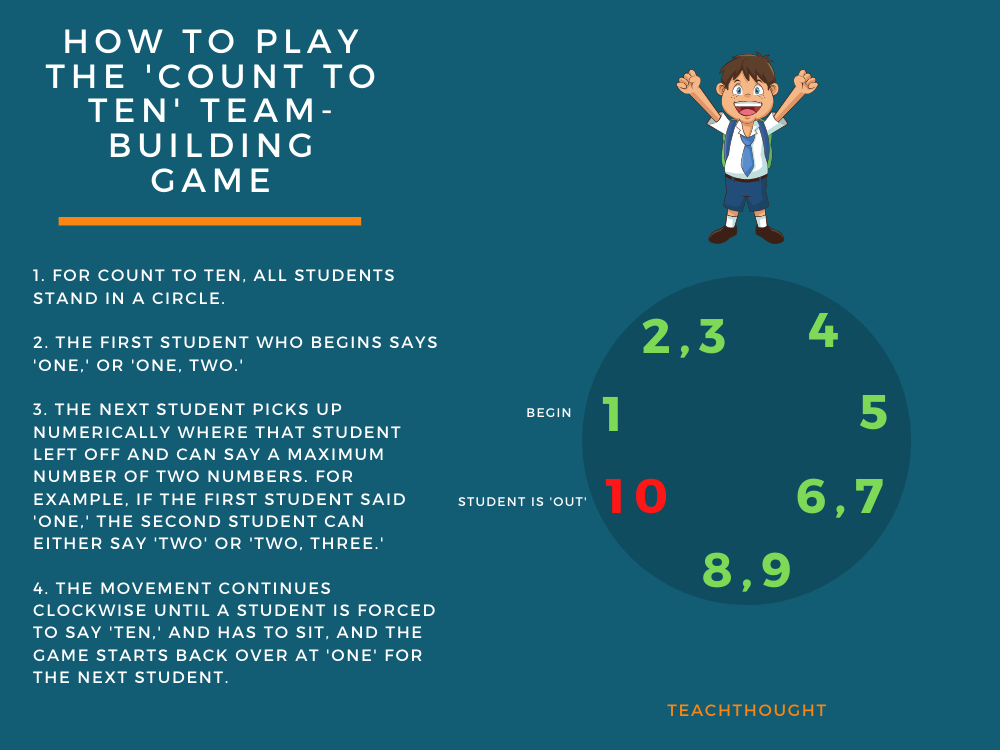
by TeachThought Staff We’ve looked at icebreakers for kids–elementary school students, for example. How about another of an easy to use, fun, and fairly quick/zero-prep team-building game? One that can be used with a wide range of ages from elementary to adult? If so, ‘Count To Ten’ might just fit…
-
Let’s face it. Everyone wants to learn faster. Whether you’re working with a maths tutor in Brisbane or studying on your own, your learning style matters. Many students rely on math tutors or English tutors to speed things up, but sometimes what holds them back isn’t effort — it’s misinformation.…
-
Standing for Critical Thinking and Progress by Terrell Heick At TeachThought, we have always focused on promoting critical thinking cross for use in ‘human’ applications–namely, people (i.e., education stakeholders) and places (i.e., communities). Our mission has been apolitical by design—centered on improving thought, education, and human potential without aligning with…
-
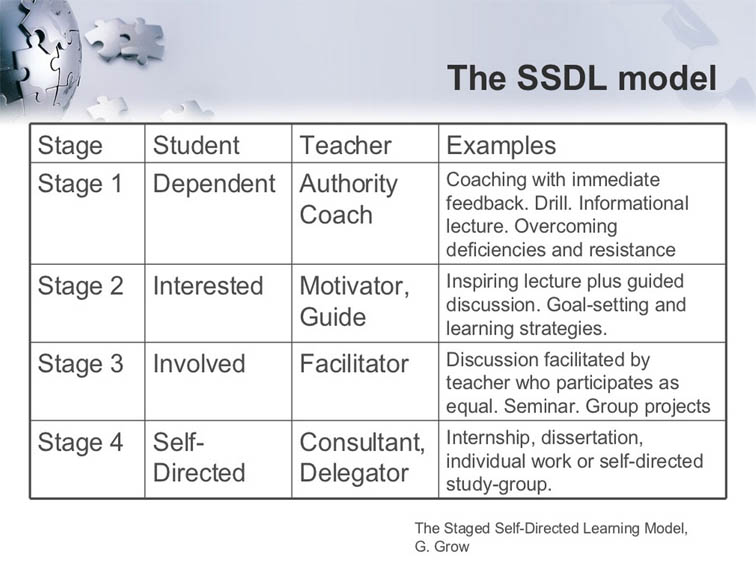
by TeachThought Staff Self-Directed Learning is not a new concept, but it’s often misunderstood—especially in the context of K-12 classrooms. In a prior reflection, Terry Heick explored the relationship between self-directed learning and the true purpose of education: “The goal of the model isn’t content knowledge (though it should produce that),…
-
What Is Cognitive Dissonance? A Definition For Teaching Understanding Cognitive Dissonance: A Psychological Framework for Growth and Learning Human beings strive for consistency between their thoughts, beliefs, and actions. When an inconsistency arises—when beliefs and behaviors clash—it creates a sense of discomfort or tension known as cognitive dissonance. This…
-
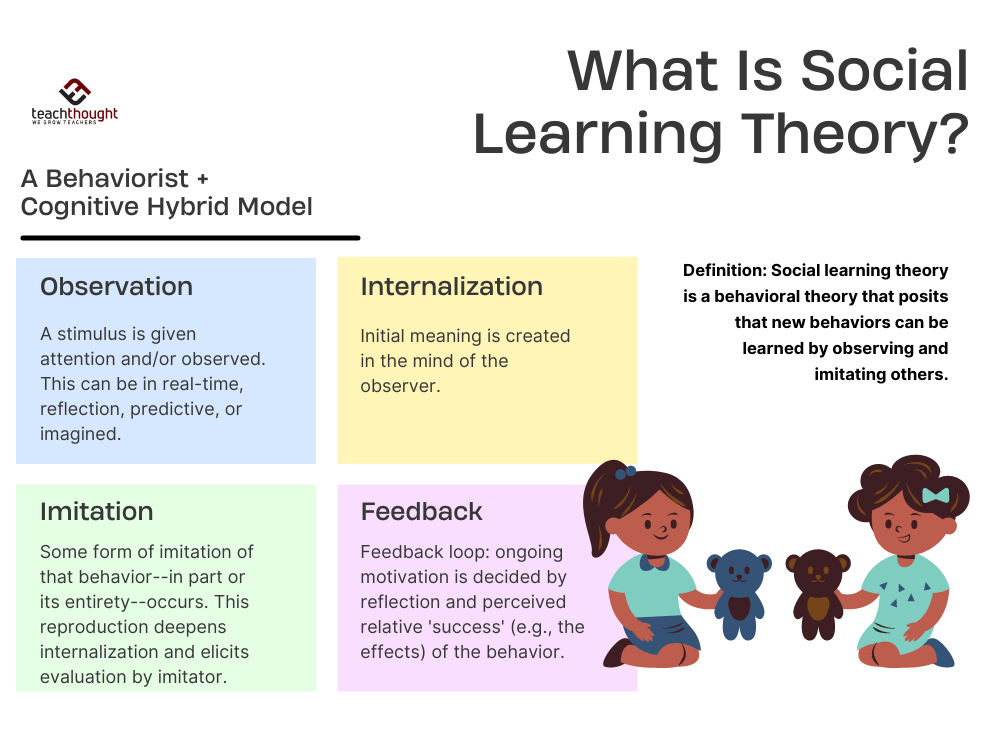
What is social learning? Social learning theory is a behavioral theory that posits that new behaviors can be learned by observing and imitating others. It is underpinned by the idea that meaning-making (i.e., learning) is a cognitive behavior and process that occurs in social settings. And it is the possibility…
-

A List Of Free MOOCs For Teachers & Students contributed by TeachThought Staff While the initial surge of enthusiasm for MOOCs in the early 2010s has tapered off, they remain a valuable and widely-used resource for lifelong learning, professional development, and academic enrichment. Let’s take a look at how and…
-
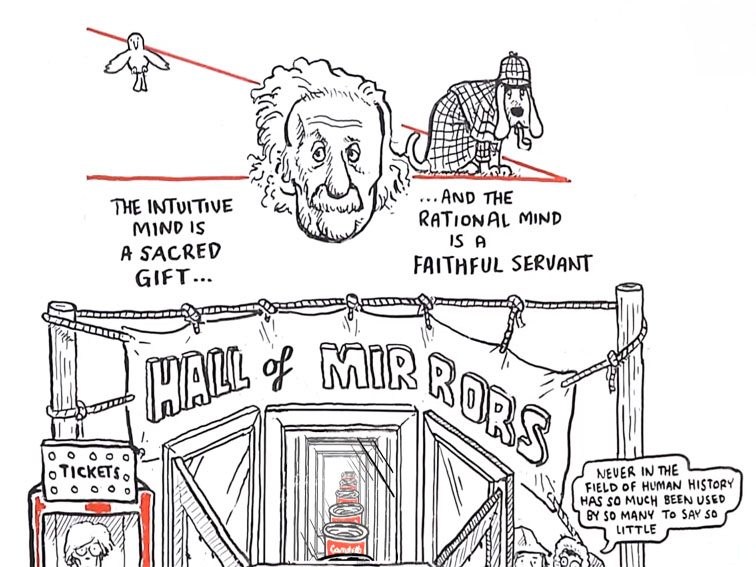
by TeachThought Staff Understanding how the brain actually learns has been a a scientific challenge for millennia. Based on recent advances in neuroscience and its application to learning, there is an emerging model of how the brain learns and it is unlike anything that was expected. It is suggested that…
-
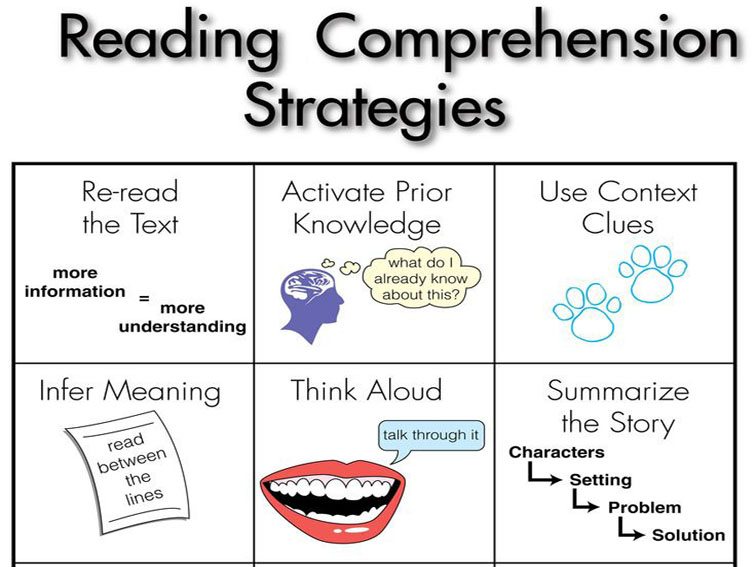
by TeachThought Staff Reading is simply a sequence of symbol interpretation. By understanding that letters make sounds, we can blend those sounds together to make whole sounds that symbolize meaning we can all exchange with one another. By mastering the symbols and their most common contexts, reading becomes a practice…
-
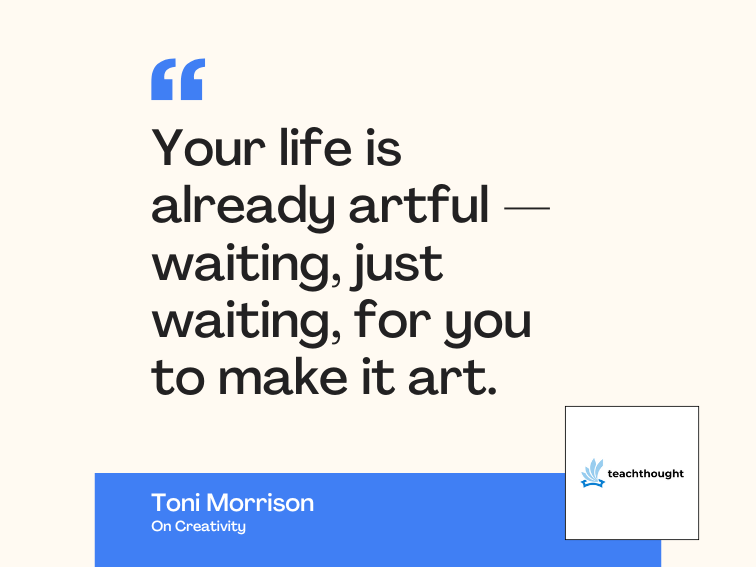
by TeachThought Staff In the always-changing–recently even more so–landscape of education, the cultivation of creativity is a vital component of learning. Combinig existing ideas into new forms–into new ideas–is a part of creativity. More than just an artistic endeavor, creativity can lead to curiosity, enhances problem-solving capabilities, and can–well-implemented–a deeper,…
-
A critical thinking strategy is simply a ‘way’ to encourage or facilitate the cognitive act of thinking critically. Critical thinking is the ongoing application of unbiased, accurate, and ‘good-faith’ analysis, interpretation, contextualizing, and synthesizing multiple data sources and cognitive perspectives in pursuit of understanding. What are the 7 critical thinking…
-
Good training data is key for AI models. Mistakes in data labeling can cause wrong predictions, wasted resources, and biased results. What is the biggest issue? Problems like unclear guidelines, inconsistent labeling, and poor annotation tools slow projects and raise costs. This article highlights what is data annotation most common mistakes. It also offers practical tips to boost…
-
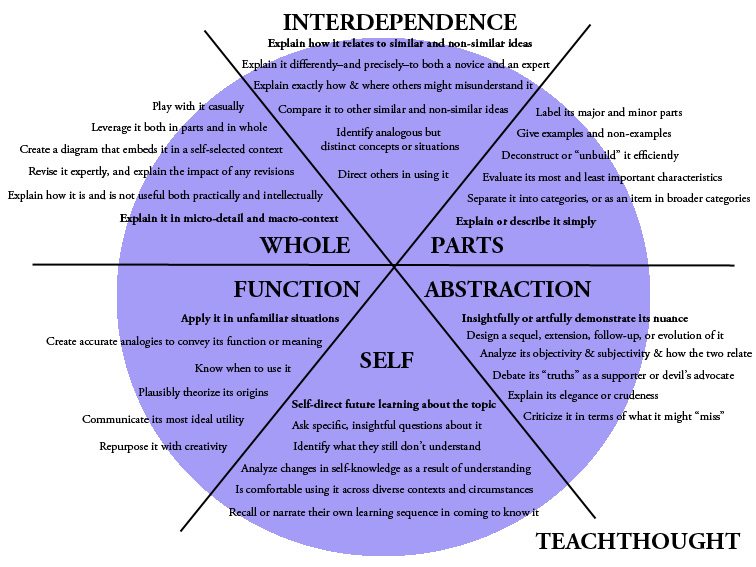
by Terry Heick How can you tell if a student really understands something? They learn early on to play the game—tell the teacher and/or the test what they ‘want to know,’ and even the best assessment leaves something on the table. (In truth, a big portion of the time students…
-

Social media content creators make anywhere from $500 to $50,000+ monthly. Learning to edit videos that stand out on social media platforms is a vital skill in today’s digital landscape. CapCut brings professional editing tools to everyone, whether you’re new or want to level up your content game. We found…
-
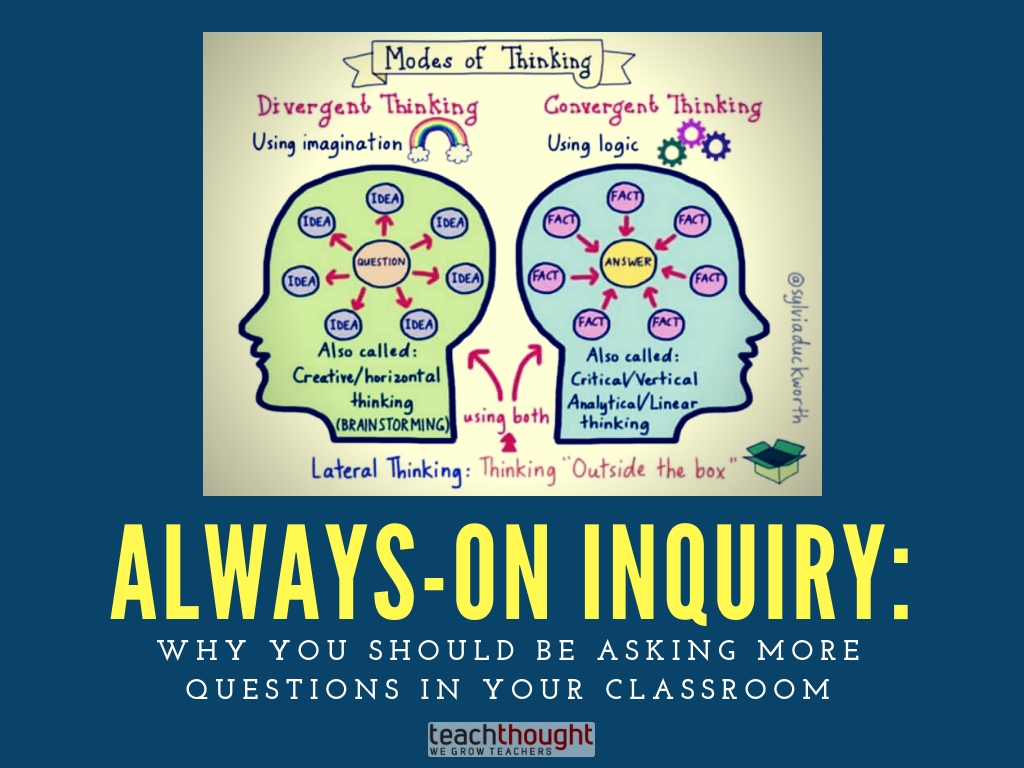
contributed by Irena Nayfeld, TeachThought PD Inquiry Workshop Facilitator Those of us who spend our days around young children hear it all the time: “What’s that?” “Why are you doing that?” “How?” “Why?” “HowWhyWhenWhatWhy?” Children are infinitely curious – they want to understand the world around them, how it all…
-
by Terry Heick What does ‘critical thinking’ mean? Well, that depends on who you ask. For educators, as a term, critical thinking is similar to words like democracy, global, and organic: You hear people use them all the time, but no one seems to understand exactly what they mean. This kind…
-
Billions upon billions of people in the world have been connected by the internet, which has provided the ability to access more and more information, services, and opportunities. However, as the new connectivity grows, there are greater privacy, security, and data privacy concerns regarding how personal data is to be…
-
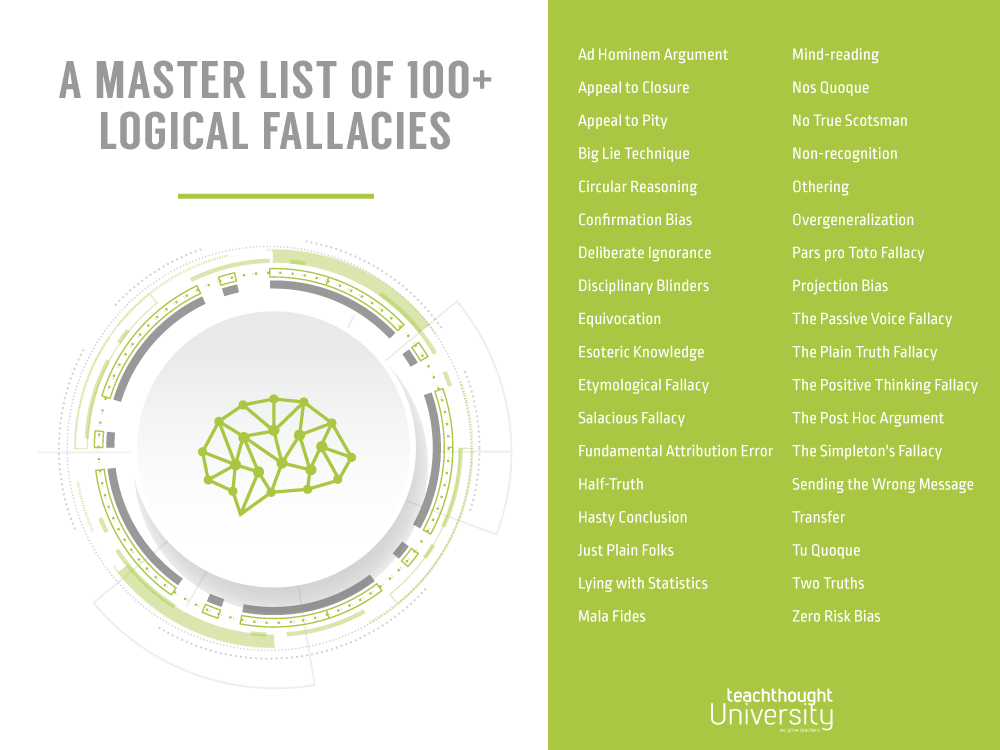
contributed by Owen M. Wilson, University of Texas El Paso A logical fallacy is an irrational argument made through faulty reasoning common enough to be named for the nature of its respective logical failure. The A Priori Argument Also: Rationalization; Dogmatism, Proof Texting A corrupt argument from logos, starting with a…
-
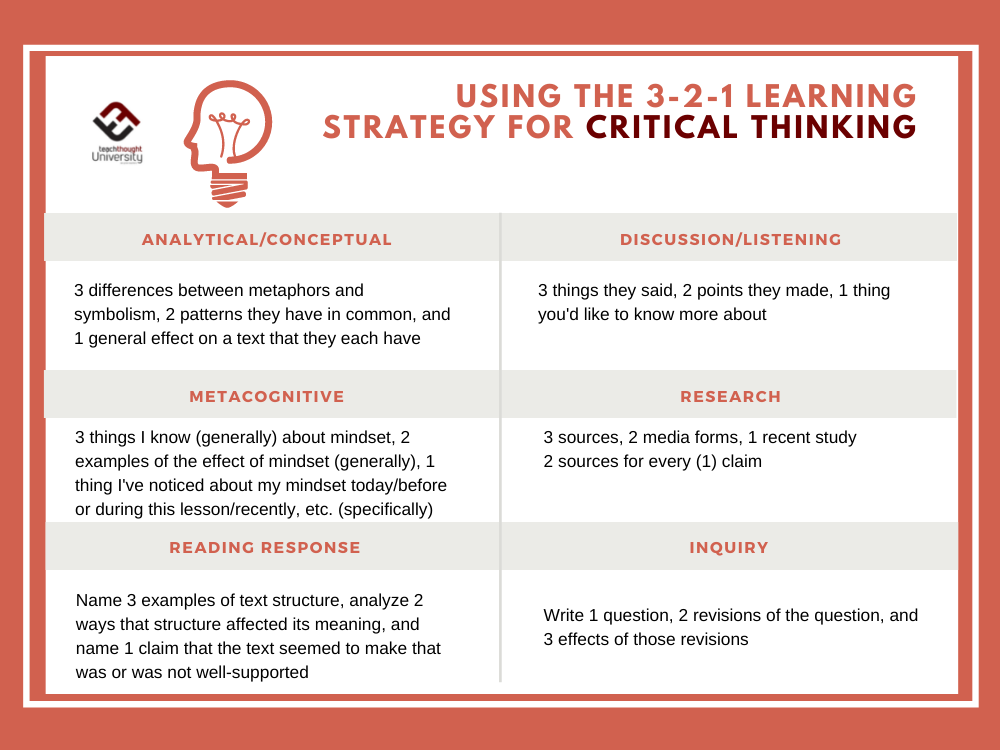
by Terry Heick What’s the 3-2-1 strategy? The 3-2-1 strategy is simply a format that can frame–well, really anything. Examples Of The 3-2-1 Strategy It doesn’t even have to be about about teaching and learning. You might ask someone to name… 3 of your favorite genres of music, 2 of…
-
Protecting Student Data In The AI Classroom With A VPN AI is transforming education, but with increased tech comes increased responsibility. Educators must prioritize data privacy, especially as AI tools gather student information. Let’s take a quick look at how VPNs offer a practical solution for safeguarding data in the…
-
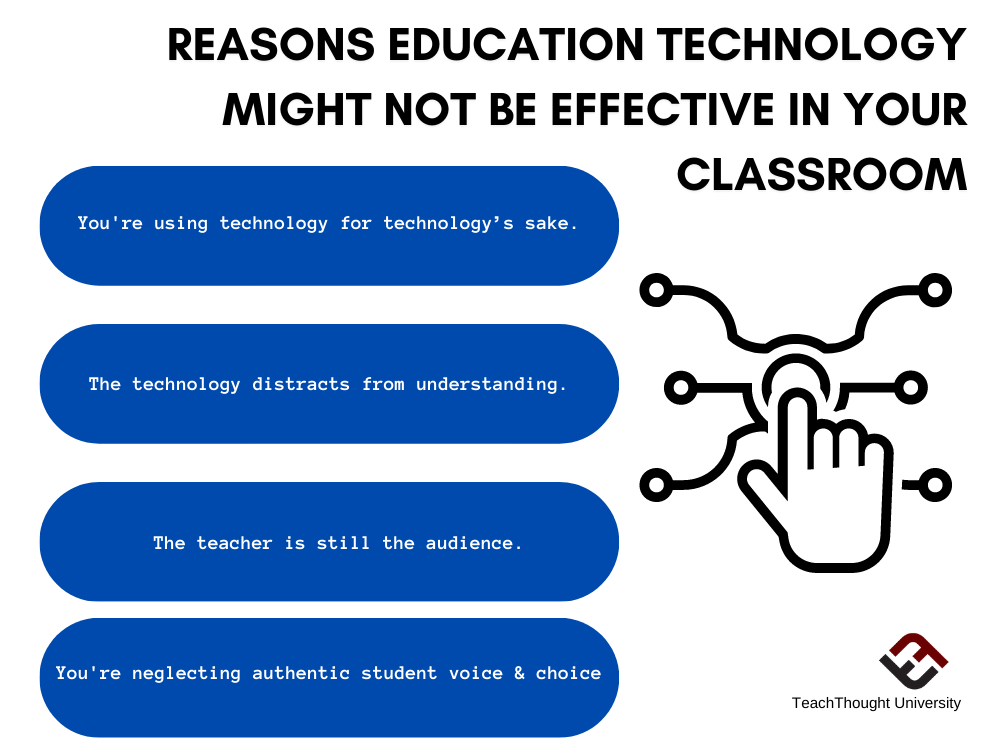
The world is changing fast, and traditional education often fails to keep up. While students are taught math, science, and history, many leave school without the financial knowledge and problem-solving skills needed to thrive in the real world. This is where an entrepreneurial mindset becomes essential. An entrepreneurial mindset isn’t…
-
by Terry Heick The long-term output of any school should be not just proficient students, but enabled learners. An “enabled” learner can grasp macro views, uncover micro details, ask questions, plan for new knowledge and transfer thinking across divergent circumstances. This doesn’t happen by content “knowledge holding,” or even by…
-

In this blog, we’re diving into 10 game-changing ways a simple video clipper can save you tons of time and make your editing workflow smoother than ever. Precise Removal of Unwanted Footage Editing raw footage can often feel akin to chiseling a masterpiece from an unwieldy block of marble. The…
-

College students face rising costs for education every year, causing many to juggle work, studies, and looming debt. The CollegeBoard’s report shows that the average cost and fees at private four-year colleges in 2021–2022 was approximately $38,070 per year, while public in-state four-year colleges averaged around $10,740 per year. For…
-
by Terry Heick This is a quick post that just occurred to me while writing about–well, writing about writing. I was brainstorming ways to use technology to help students improve their writing and realized that over and over again, I was thinking about the process of writing and how crucial…
-
I. Human beings are capable of extraordinary joy and extraordinary suffering. II. Suffering is inherent in the human condition and is not entirely correctable. III. Suffering that occurs as a kind of product–something occurring by design–is, however, correctable. IV. Many of the issues that cause suffering do, in fact, occur ‘by…
-
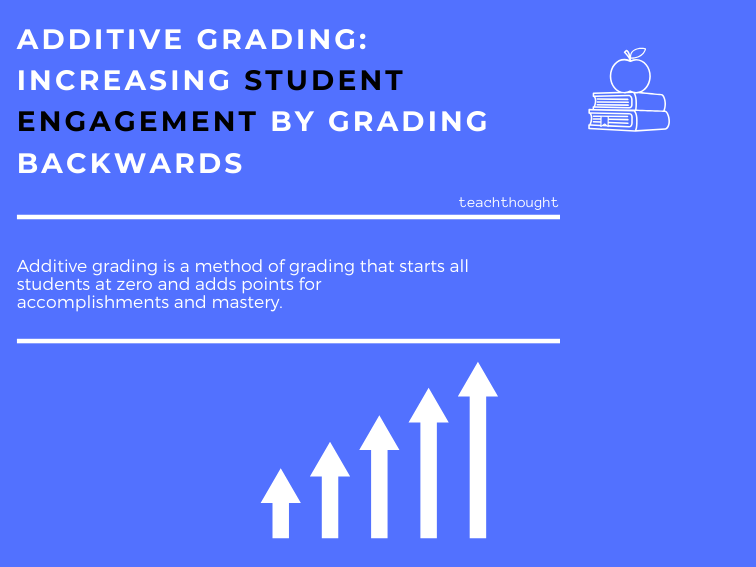
contributed by Rob Steller Engagement isn’t an on and off switch. There are levels to student engagement and if a mind isn’t engaged, it’s nearly impossible for it to learn. In a way, education is already set up like a game. Students earn points (grades), gain levels (grades), and in a…
-
Cybersecurity 101: Essential Tips for Students & Teachers The rise of digital learning has transformed education, providing unprecedented connectivity and opportunities. However, this shift also brings serious challenges, particularly in online privacy and security. To navigate this evolving landscape, both students and educators must understand the essentials of cybersecurity. In…
-
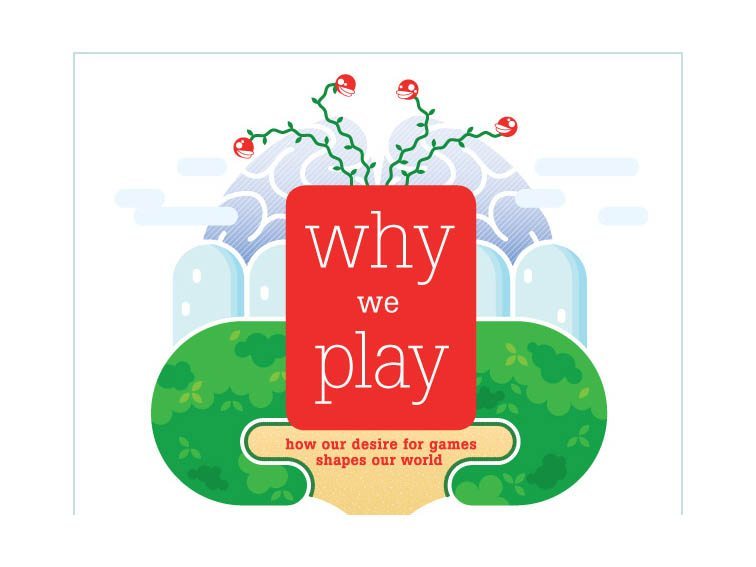
Why People Play Video Games Why We Play Video Games: How Our Desire For Games Shapes Our World was first published in Game Informer magazine and then on gameinformer.com by Ben Reeves Gamers have spent countless hours saving princesses, dodging bullets, and dismembering Grecian monsters. What drives us to keep coming back…
-

Critical thinking is a skill we’re told to cultivate, like reading literature or maintaining eye contact during small talk. It’s about stepping back, analyzing, and questioning everything, even when it would be so much easier to just agree with the loudest person in the room. But not all of us…
-
by Terry Heick Simple premise, as titled: what sorts of ‘things’ make teaching unsustainable, and what sort of advice can help teachers reflect on these ideas to mitigate any damage and make the profession more enjoyable, and thus sustainable. 10. Grow a healthy and useful professional learning network. See also…
-
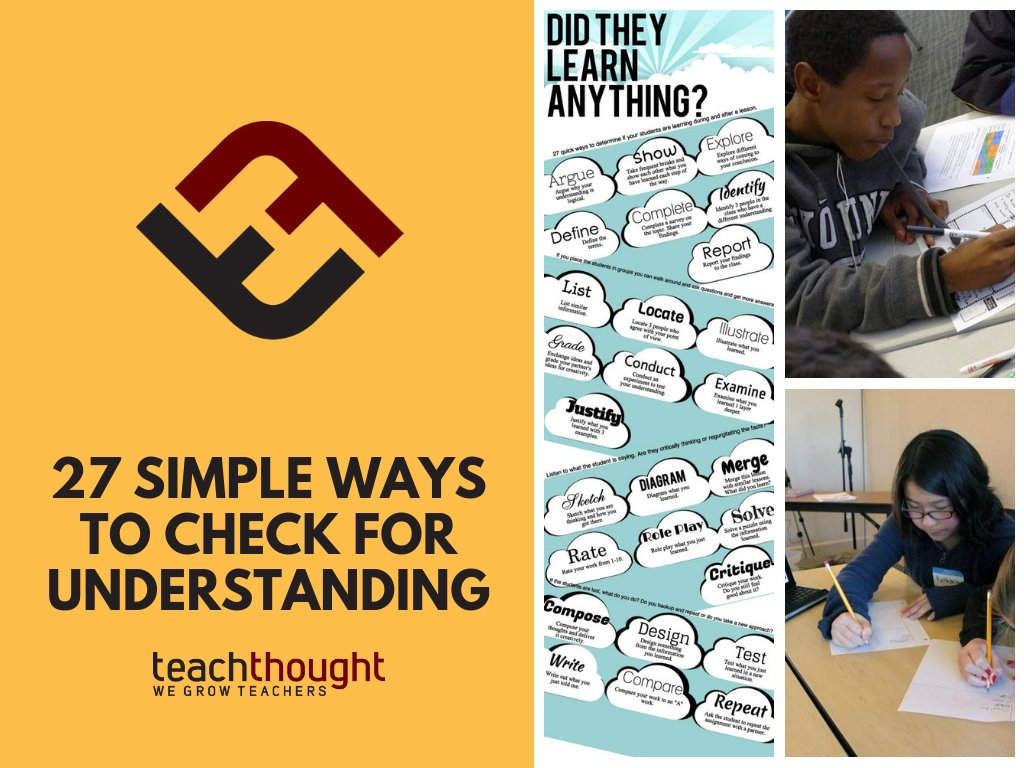
Whether you’re using formative assessment for data to personalize learning within a unit, or more summative data to refine a curriculum map, the ability to quickly and easily check for understanding is a critical part of what you do. (Which was the idea behind 10 Assessments You Can Perform In…
-
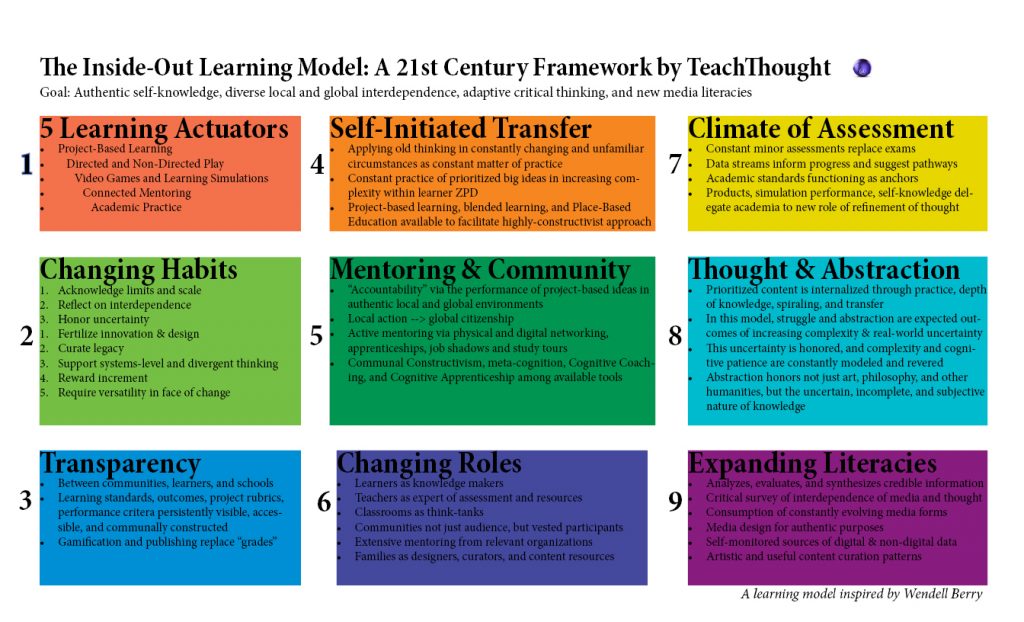
by Terry Heick As a follow-up to our 9 Characteristics of 21st Century Learning we developed in 2009, we have developed an updated framework, The Inside-Out Learning Model. The goal of the model is simple enough–not pure academic proficiency, but instead authentic self-knowledge, diverse local and global interdependence, adaptive critical thinking,…
-
The Precious First Few Minutes Of Class The traditional scene is familiar: Students drift into class while we announce “Your warm-up is on the board,” followed by the usual shuffle for supplies and various requests. But in today’s educational landscape, we can do better with these precious opening minutes. Why…
-

To grow, teachers must be able to reflect critically on their own performance. Education is ‘actuated’ by teachers. It makes sense, then, that education should also be able to reflect critically on its own performance as well. Currently, this occurs through the comforting precision of analysis and numbers. The language…
-
In today’s digital landscape, social media platforms have become crucial for educational engagement, especially in STEM fields. TikTok, a leading short-form video-sharing app, has gained immense popularity globally. Yet, in the USA, access to TikTok is restricted, hindering students and educators from tapping into its educational value. This piece delves…
-
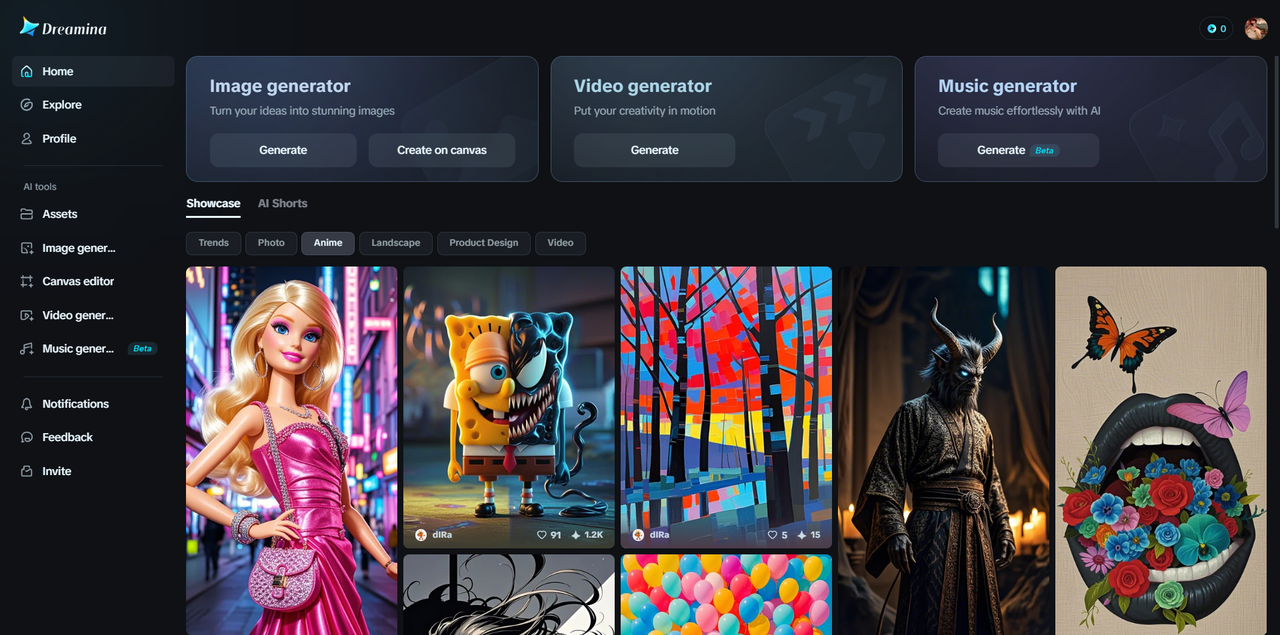
In the digital age, branding has evolved into an art and a science, requiring businesses to craft unique visual identities that resonate with their audiences. Artificial Intelligence (AI) is at the forefront of this revolution, offering innovative tools to simplify and amplify the design process. From creating eye-catching logos to…
-

Everyone loves Instagram Reels. Content creators are facing high competition to gain the attention of their audience. Attractive and clean reels always gain popularity. CapCut, free video editing software, provides a clear interface, which makes video editing for Instagram reels simple for everyone. Users can promptly discover tools and features…
-
Use Classroom Management Platforms and Other Tools to Overcome Barriers in Learning a Language contributed by Al Kingsley, CEO of NetSupport Teaching a language, whether for ESL students or those learning something new like French or Spanish – requires largely the same teaching skills as any other subject. Yet, in…
-

College planning often feels overwhelming for families. Parents juggle excitement about their child’s future with anxiety over the financial, emotional, and logistical challenges ahead. Many don’t know where to start, and as educators, we’re in a unique position to offer clarity and guidance. By helping parents understand the process early…
-
The massive T-Mobile data breach in 2023, which exposed 37 million customers’ data, was a stark reminder: cybersecurity isn’t just IT jargon—it’s a necessity in our digital world. Whether you check your bank balance on your phone, work remotely, or browse social media, your digital footprint is vulnerable to increasingly…
-

Harnessing Kairos: Balancing Structured Time and Learning Velocity in K-12 Classrooms Time in education is about more than minutes on the clock or adhering to rigid schedules. It’s about how students experience time cognitively and emotionally in the learning process. A deeper dive into these ideas reveals actionable ways to…
-
by Terry Heick Reflection is a fundamental tenet of learning; it is also, therefore, a fundamental part of teaching. Why it happens is a matter of humility. But how and when it happens–and with whom–is less clear. This is partly because there are multiple sides to reflection–length, width, and depth.…
-
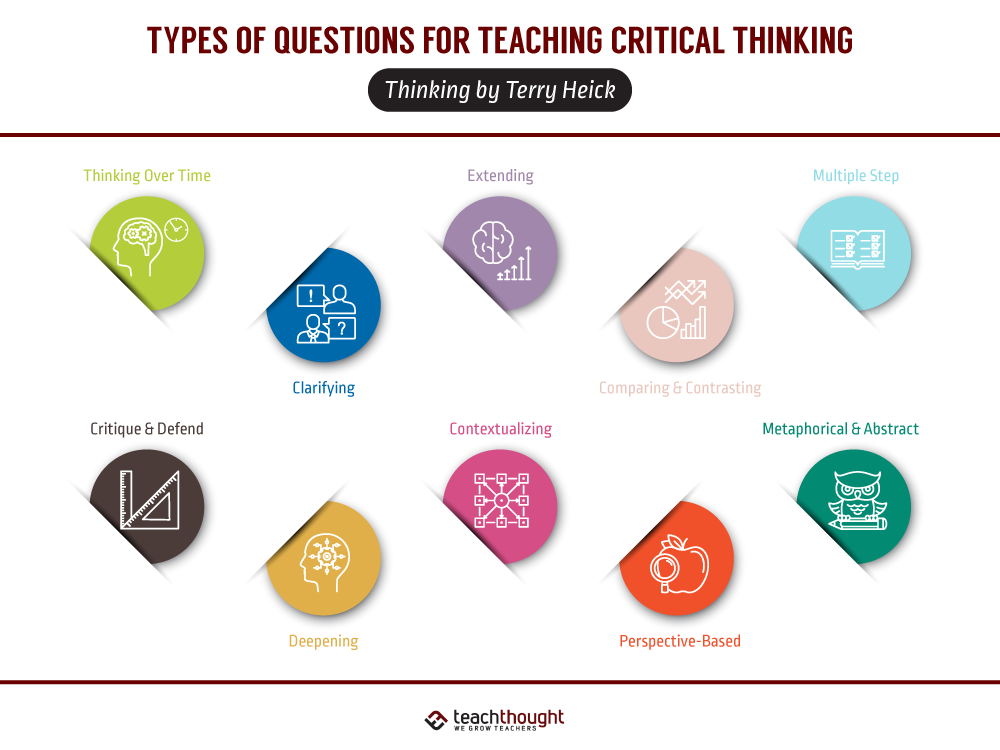
by Terry Heick What are the different types of questions? Turns out, it’s pretty limitless. I’ve always been interested in them–the way they can cause (or stop) thinking; the nature of inquiry and reason; the way they can facilitate and deepen a conversation; the way they can reveal understanding (or…
-

by TeachThought Staff In a world filled with noise, division, and endless demands on our attention, Wendell Berry’s poem The Peace of Wild Things offers a rare invitation: to step back and find solace in nature. ‘The Peace Of Wild Things,’ read slowly enough, can remind us of the deep,…
-
by Grant Wiggins & The TeachThought Staff Admit it–you only read the list of the six levels of Bloom’s Taxonomy, not the whole book that explains each level and the rationale behind the Taxonomy. Not to worry, you are not alone: this is true for most educators. But that efficiency comes…
-

The Best Science Podcasts by TeachThought Staff Today, there is a wealth of content out there that’s both educational and entertaining, including some pretty amazing shows on scientific topics that are equally interesting to the layman and the professional. Whether you’re just getting into listening to science podcasts or are…
-
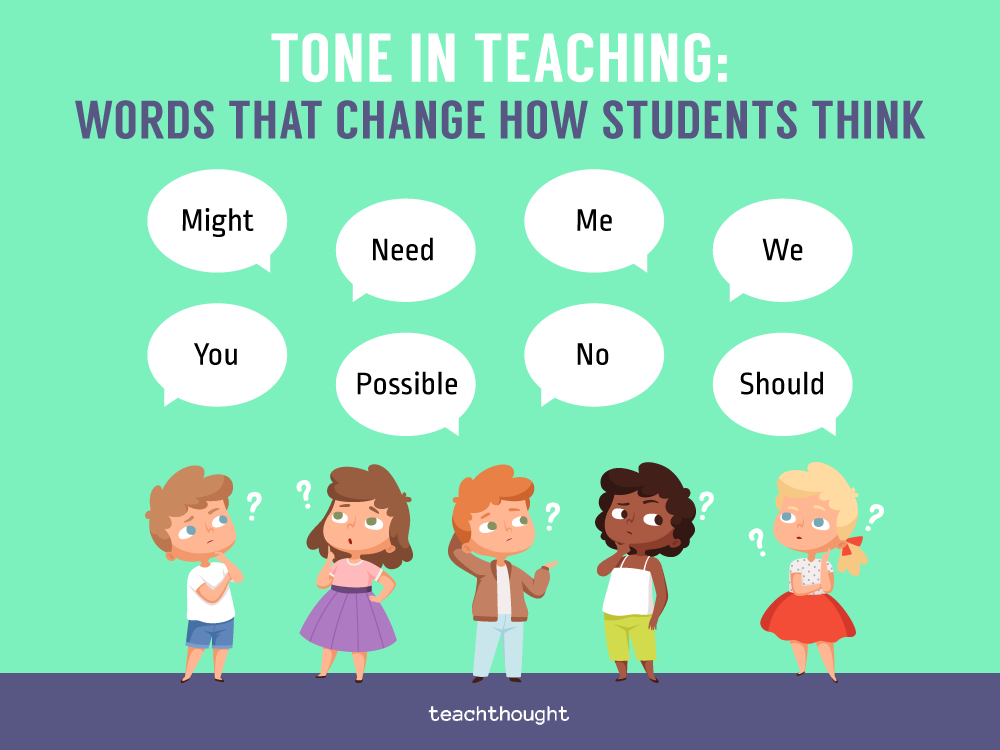
Tone As A Cause And Effect Of Learning by Terrell Heick In 20 Words That Can Affect How Students Think,, we said “Tone affects how students see themselves and their role in the learning process. In fact, a student’s own ongoing internal dialogue and thoughts about themselves and their self-identity…
-
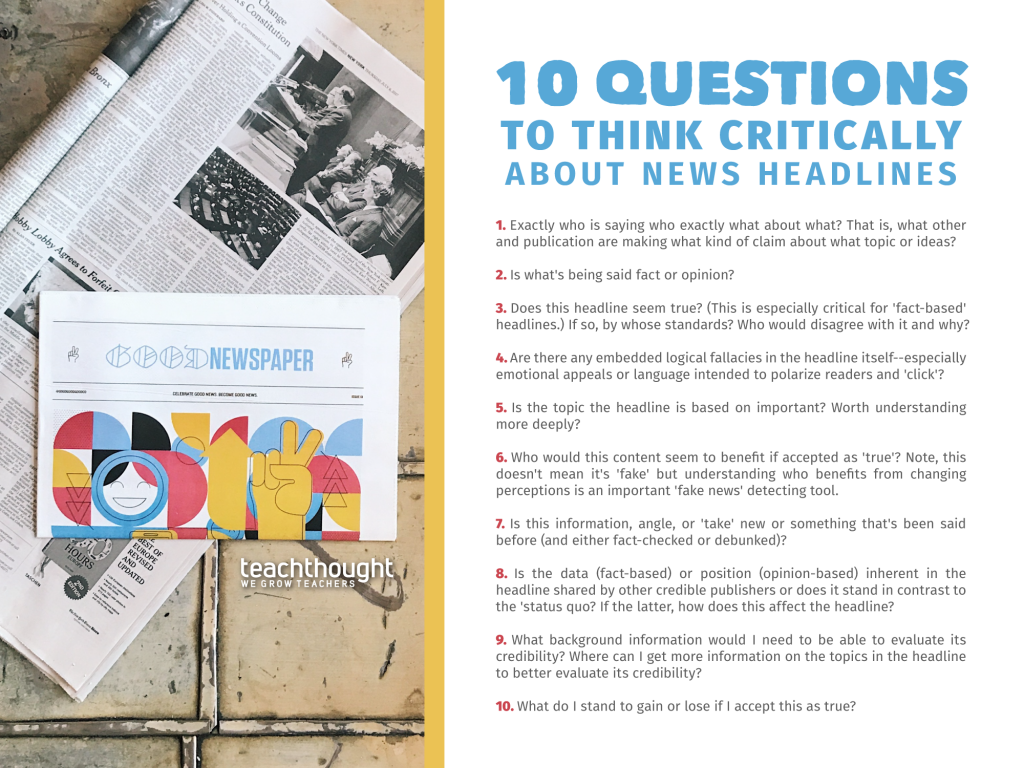
This post was originally published in 2019 and updated in 2024 by Terrell Heick 1. In the article, headline, or social share, ‘who’ is saying ‘what’? That is, what specific author and publication are making what kind of claim about what topic or ideas? 2. Is what’s being stated or…
-
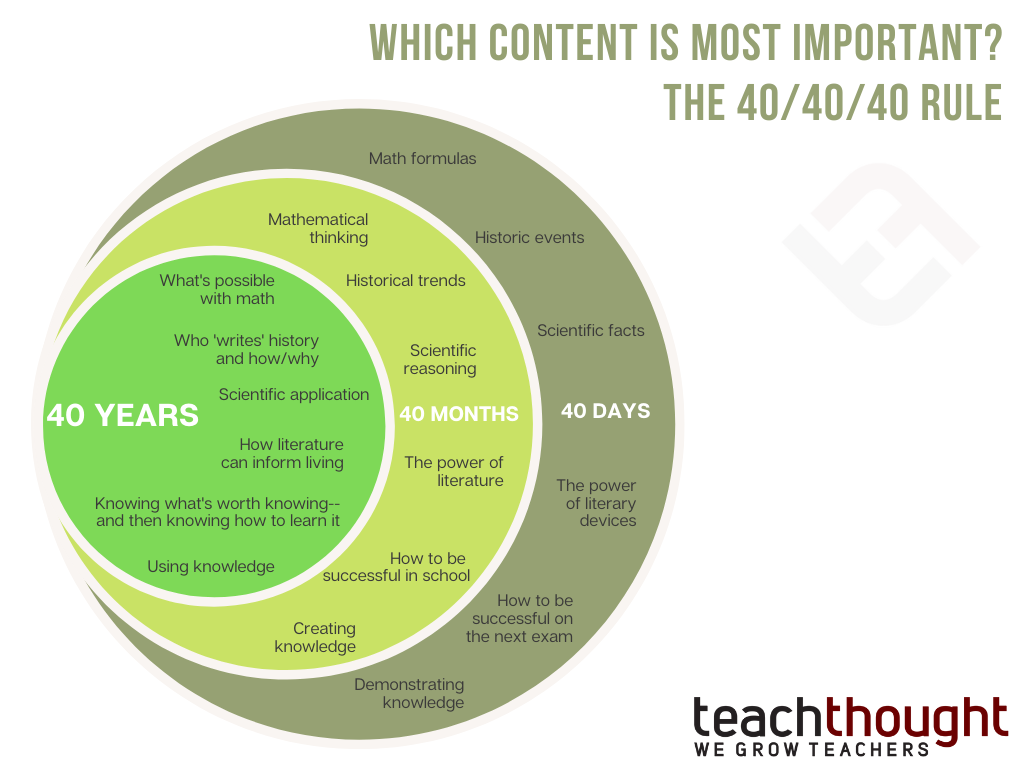
by Terry Heick I first encountered the 40/40/40 rule years ago while skimming one of those giant (and indispensable) 400 page Understanding by Design tomes. The question was simple enough. Of all of the academic standards, you are tasked with ‘covering’ (more on this in a minute), what’s important that…
-
by Terry Heick In a profession increasingly full of angst and positioning and corrective policy, there are few ideas as easy to get behind as equity. Equal. Equality. Equity. Equilibrium. Equate. These are all fine ideas—each tidy and whole, implying their own kind of justice while connotating the precision of…
-
Gamification is used in many fields and industries. It is meant to promote customer loyalty in business: ” Find a discount among our 5 latest emails to get 50% off dedicated server hosting.” It’s a little different in education. Gamification in education aims to provide a more interactive learning experience…
-

There are many obstacles to navigate when running a business. Challenges are around every corner, and one wrong move can cost you. But what if you could remove some of those risks, especially when protecting your business assets? Keeping everything safe can be daunting whether it’s your physical equipment or…
-
by TeachThought Staff The internet loves many things. It loves cats, for example. Memes, too. It loves videos, which means it loves YouTube. It loves recipes and Wikipedia and alarming misdiagnoses on WebMd and, among other things (and getting to the point here), quotes. This is partly due to the…
-

50 Inspirational And Motivational Quotes by TeachThought Staff What are some of the most inspirational quotes about life? Well, that depends on what kind of inspiration you’re looking for. Life quotes range across the human condition, from suffering to possibility, hope to sacrifice, love to loss. The best quotes about…
-
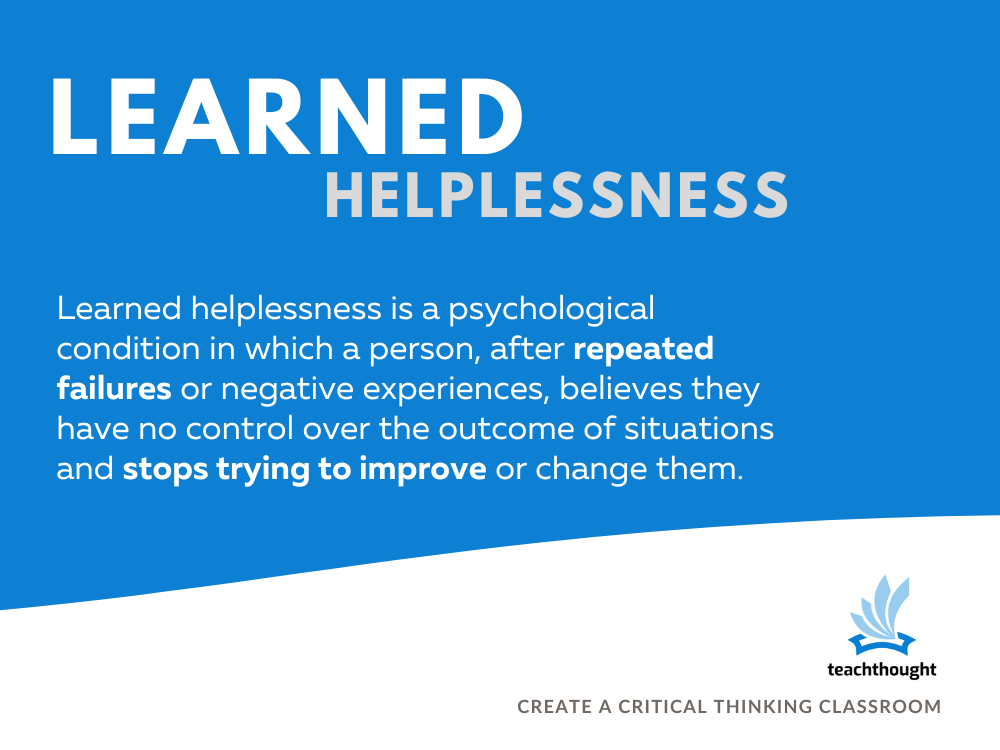
by TeachThought Staff What is learned helplessness? Definition Learned helplessness is a psychological condition in which a person, after repeated failures or negative experiences, believes they have no control over situations’ outcomes and stops trying to improve or change them. Below is an example of Learned Helplessness in the classroom.…
-

We make lasting connections through play, but the role of play in learning is an idea that continues to meet resistance. Part of the reason could be tone. We like our learning serious, intentional, and academic. This is reflected through a parallel insistence on an outcomes-based learning system where learning…
-

by TeachThought Staff AI-Driven Climate Modeling Researchers use advanced AI models to predict climate changes more precisely. This project integrates machine learning with global climate data to simulate potential outcomes. The goal is to identify key mitigation strategies for climate adaptation. By improving accuracy, policymakers can make better-informed decisions to…
-
by TeachThought Staff Definition: Duolingo is a popular language-learning platform that provides free online courses in multiple languages. Audience: K-12 Teachers, Students It offers a gamified approach to language learning, making it engaging and interactive for users. Duolingo offers courses in over 40 languages, including widely spoken languages like English,…
-
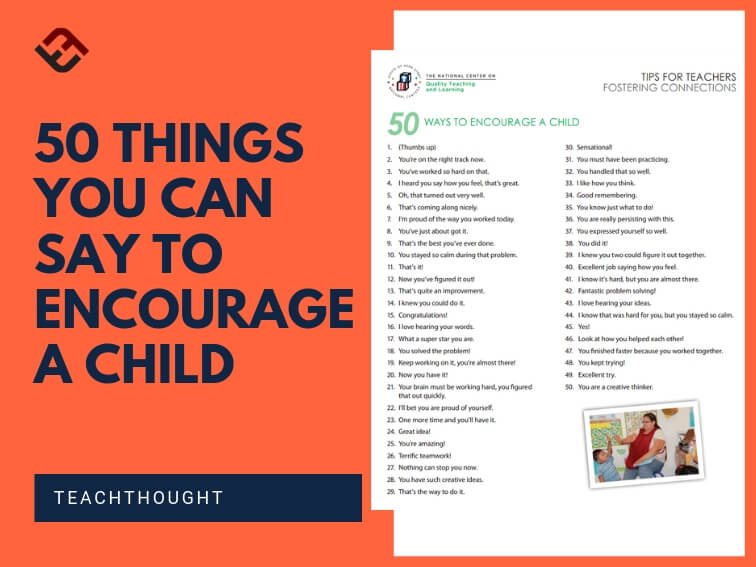
by TeachThought Staff There are many ways to encourage a child, but for students of any age, honest, authentic, and persistent messages from adults that have credibility in their eyes are among the most powerful. The National Center on Quality Teaching and Learning has put together the following list, 50 Ways…
-
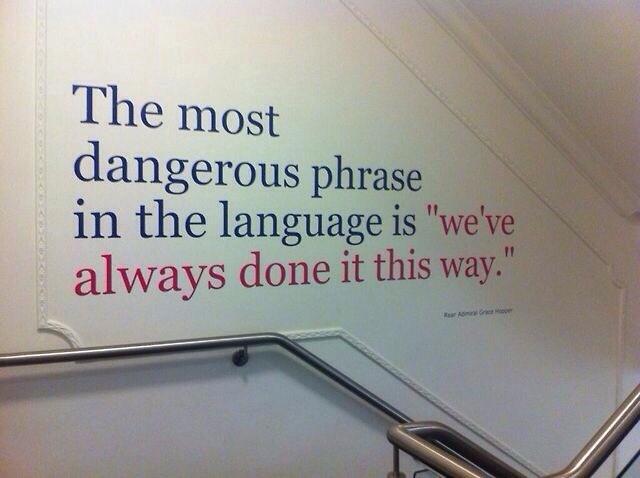
by Terry Heick I was speaking (tweeting) with Mark Barnes tonight, and he mentioned the idea of challenging existing forms and practices. And then someone tweeted the above image–a quote attributed to Rear Admiral Grace Hopper, according to the image source globalnerdy.com–and I was happy and favorited and saved and blogged.…
-
Abstract Collaboration between teachers and principals is essential for creating thriving educational communities that enhance student achievement and teacher performance. This article explores the transformative power of a collaborative, unified approach, emphasizing the need for intentional, purpose-driven collaboration. It outlines strategies and principles for fostering a culture of mutual respect,…
-
Innovative Methods in Language Learning: How Technology is Transforming Education Learning a new language is kinda like standing before the ruins of the Tower of Babel, tasked with rebuilding it. The stones are so large… so many. They look so heavy. Where do you start? What’s the best way to…
-
For better or for worse, visual information is the new internet, and infographics are pioneers in mashing information and images together in a way that hopefully tells a story, provides utility, or both. You need a few basic ‘things’ to create infographics. 1. A tool that works (below, we have…
-
Information and Communication Overloading (ICO) and “Mindful Media” contributed by Dr. Domenico Meschino In today’s digital age, children are immersed in many online activities that shape their daily lives. Social media has become integral to their social landscape, with platforms like YouTube capturing their attention. These platforms serve as virtual…
-
by Terry Heick While I often talk about ‘scale’ as one of the primary challenges in education–and have also wondered about curriculum, too–a more subversive concept constantly at play throughout education is tone. As an ‘English’ teacher, I always explained tone to students as a kind of ‘attitude’ that can be…
-

by Terry Heick Grading problems are one of the most urgent bugaboos of good teaching. Grading can take an extraordinary amount of time. It can also demoralize students, get them in trouble at home, or keep them from getting into a certain college. It can demoralize teachers, too. If half…
-
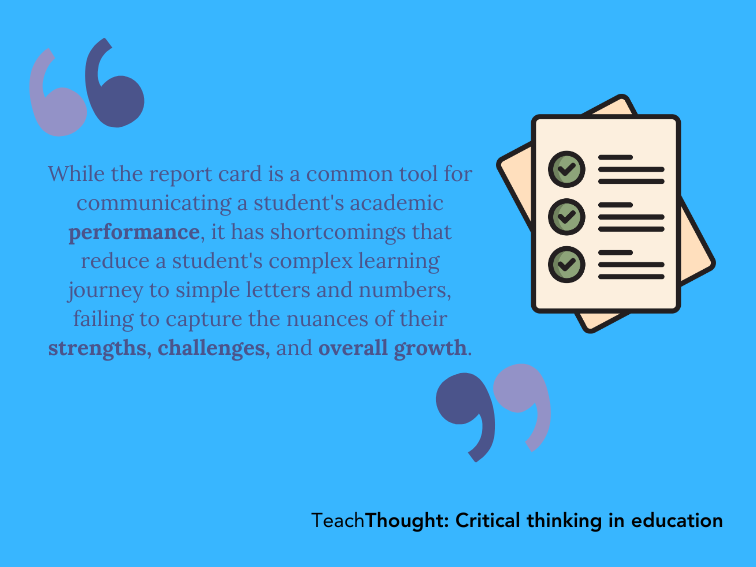
15 Alternatives To Report Cards In The K-12 Classroom by TeachThought Staff Like lunchboxes (or brown paper sacks), field trips, and textbooks, report cards are iconic–symbols of traditional classrooms and traditional approaches to education. In its name, the purpose of a ‘report card’ is plain enough: to report on progress.…
-
contributed by Dr. Kymm Ballard, Executive Director for SPARK Think about any time you’ve seen “army boot camp” portrayed in pop culture — are you picturing the traditional drill sergeant, ordering his troops to do endless laps and push-ups, as punishment for their errors that day? Now, with that scenario in your…
-
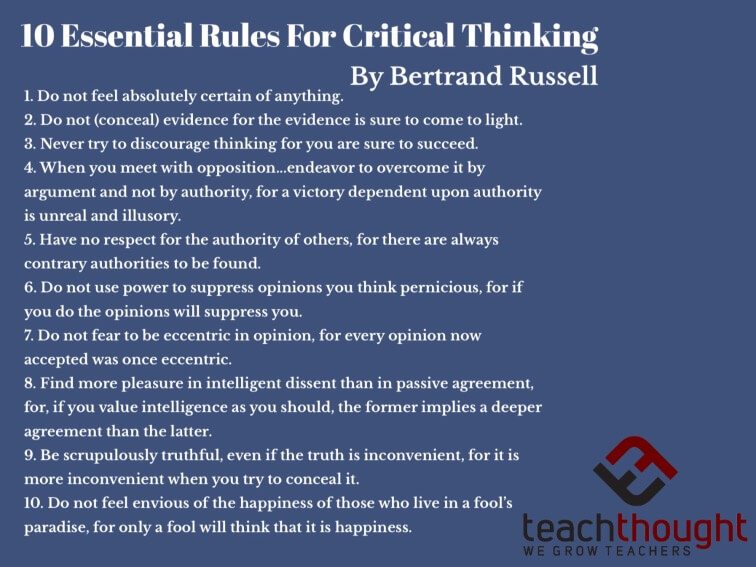
Bertrand Russell’s 10 Essential Rules Of Critical Thinking by Terry Heick For a field of study that explores the nature of knowledge, Philosophy has had a surprisingly small impact on education. Most formal academic ‘platforms’ like public schools and universities tend to parse knowledge into content areas–what is being learned–rather…
-
Labeling a book “great” is a matter of opinion, but when you pile together the opinion of 13 other book-loving folks, you start to get somewhere close to credibility. Alistofbooks.com compiles 13 lists of the greatest books ever published, using contributions from individuals and organizations ranging from The Harvard Book…
-
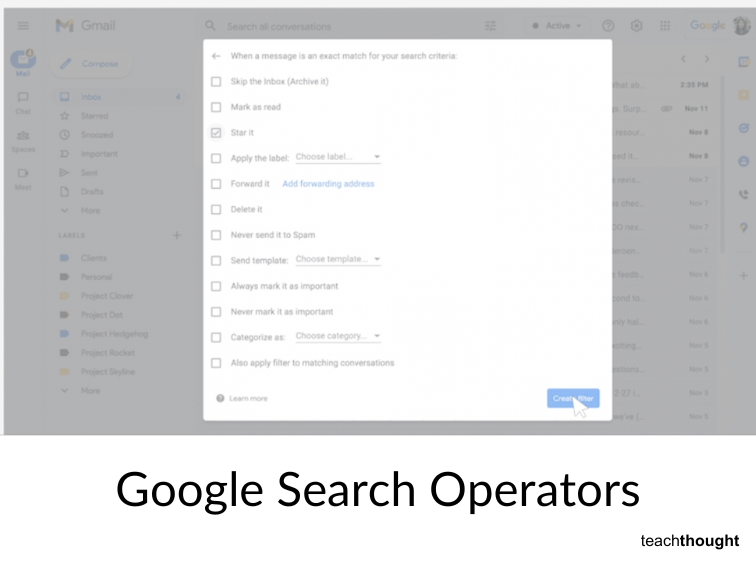
How To Filter Your Email using Search Operators by TeachThought Staff It’s almost 2025, and I’m on what seems to be a never-ending question make email better. As much as I ‘don’t like email,’ I don’t like phone calls either, but guess what? Sometimes, they’re necessary. It’s impressive that though…
-
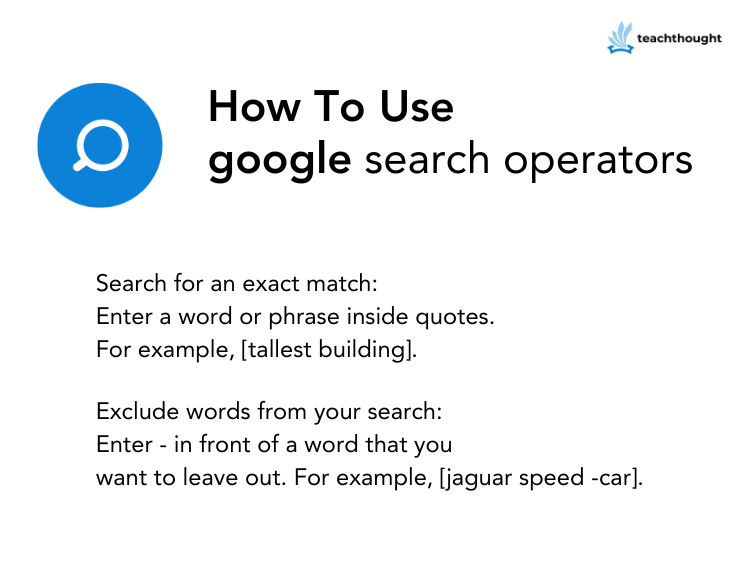
What Are Google Search Operators? by TeachThought Staff Google search operators are special characters and commands you can use to refine your search queries on Google. They help narrow down results by specifying more precisely what you’re looking for. For example, using quotation marks (“”) around a phrase will return…
-
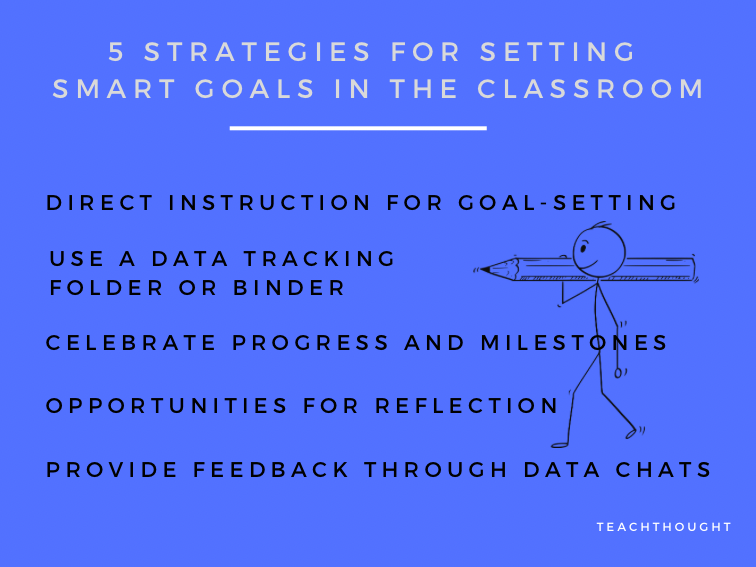
Using Goal Setting and Data Tracking to Enhance Student Agency and Achievement contributed by Samantha Lopez As educators, we are often referred to as ‘data-driven decision-makers.’ Even in an upper elementary classroom, students can access their grades and keep track of their assignments. Instead of only using data, how can…
-
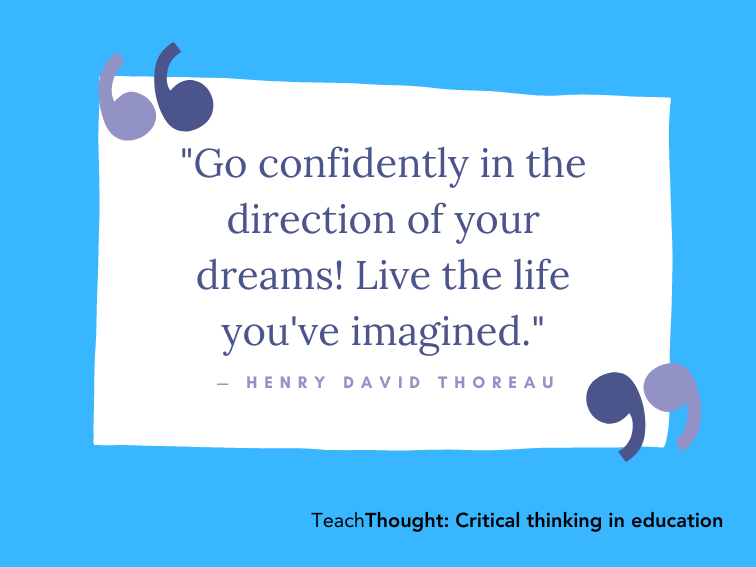
What Is Life About? The Best Quotes We Could Find by TeachThought Staff What Is Life About? The Best Quotes We Could Find “People use drugs, legal and illegal, because their lives are intolerably painful or dull. They hate their work and find no rest in their leisure. They are…
-
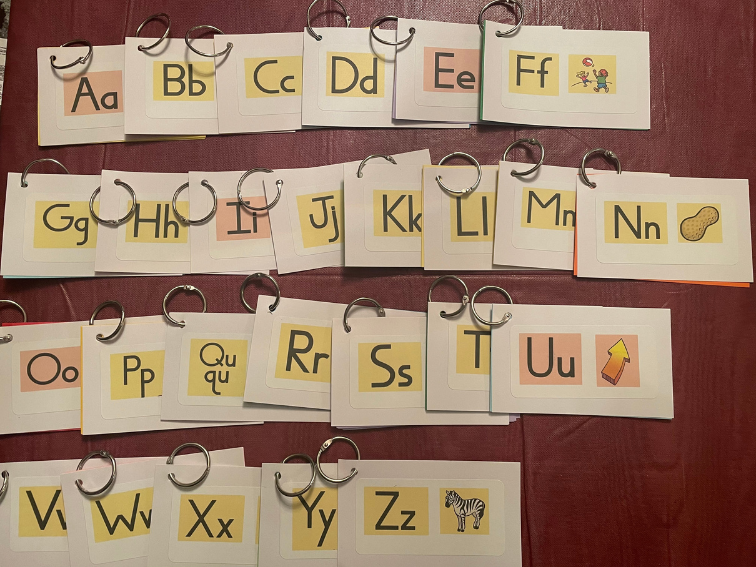
contributed by Samantha Saumell, I Have, Not I Am All teachers want to help students become successful readers and writers. Whether students like reading or writing, they are readers and writers, whether they know it or not. Students sometimes think that they only ‘write’ in school. But the truth is they…
-
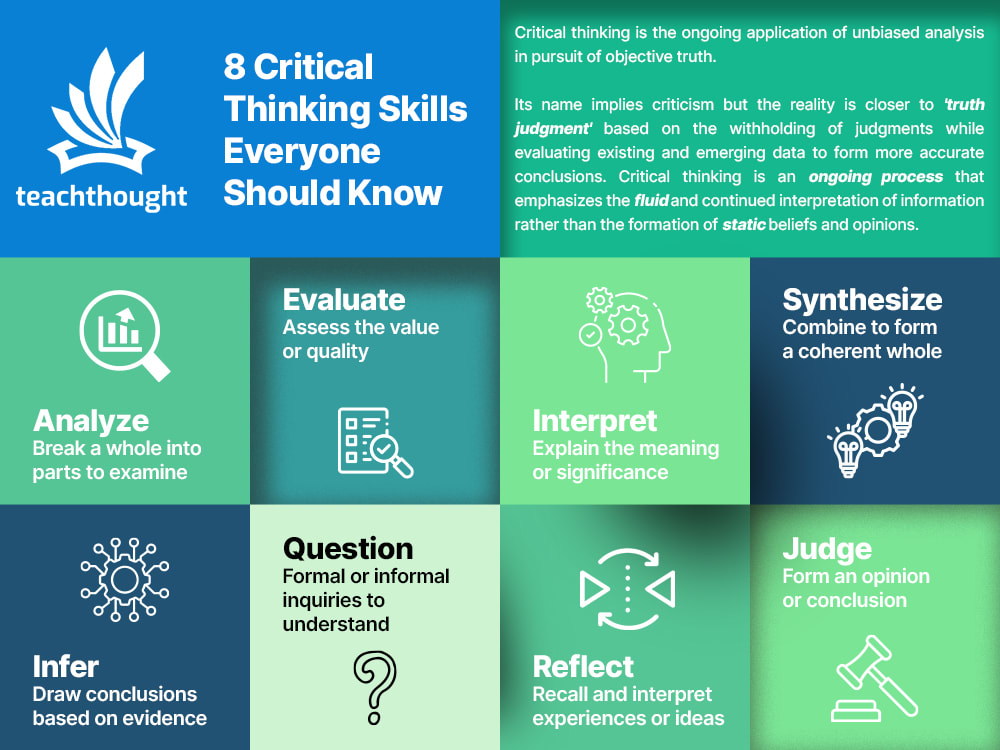
Critical thinking is the ongoing application of unbiased analysis in pursuit of objective truth. Although its name implies criticism, critical thinking is actually closer to ‘truth judgment‘ based on withholding judgments while evaluating existing and emerging data to form more accurate conclusions. Critical thinking is an ongoing process emphasizing the…
-

Education has gone beyond acquiring knowledge to acquiring skills using EdTech tools; students learn digital literacy, teamwork, and critical thinking skills. Using technology in learning also enhances the student’s ability to appreciate and ponder on issues in a previously deemed impossible manner. Thus, tech serves as an additional tool for…
-
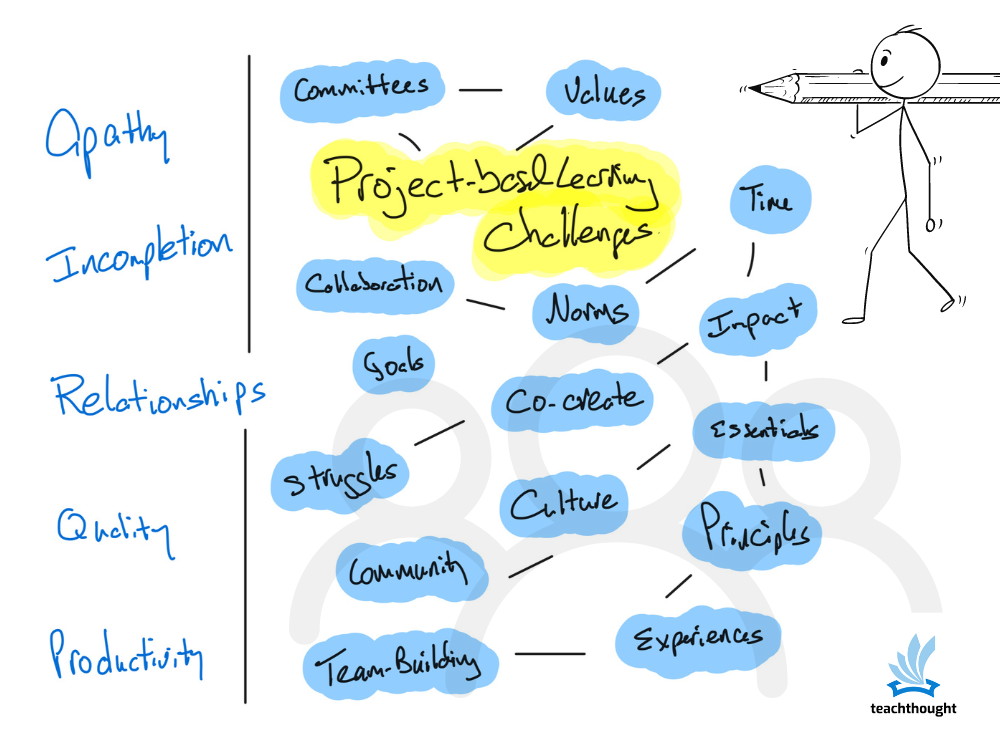
Address Common Project-Based Learning Challenges Through Culture-Building contributed by Sara Segar, Experit Learning Depot I would never claim to be the world’s best project-based educator. There have been ups and downs, some duds, and big mistakes. I have encountered every PBL challenge imaginable, but I’ve used them as opportunities to do…
-
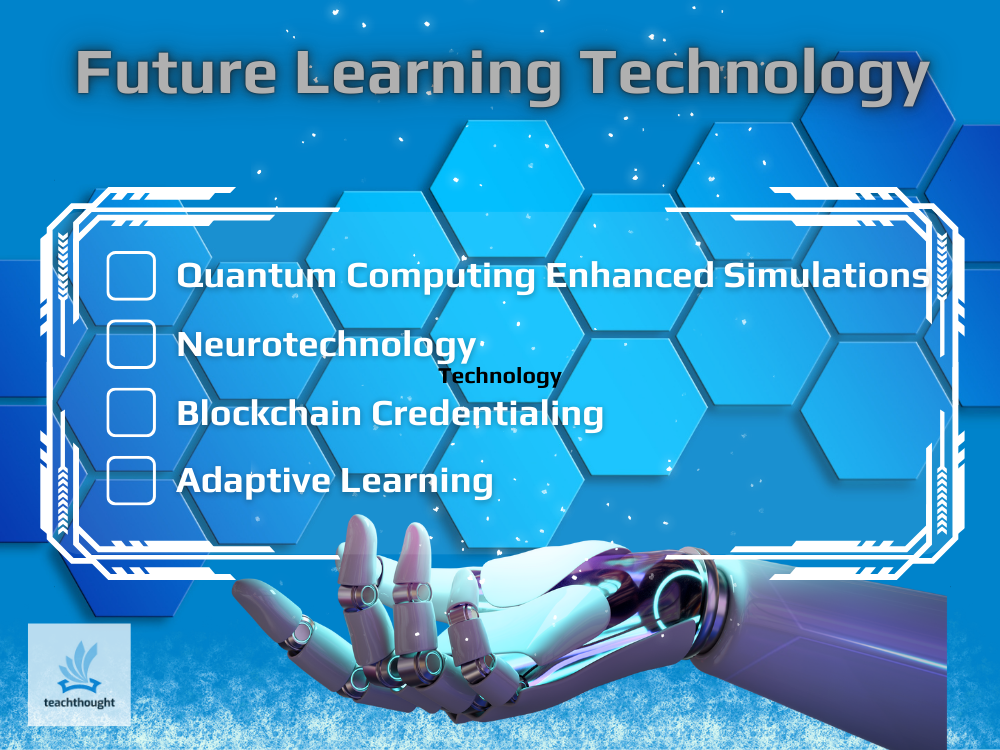
by TeachThought Staff In ‘Shifts For The Classroom of the Future,’ Terrell Heick said, “It’s challenging enough to manage a traditional learning environment where the curriculum is handed to you, and meetings are set, and you’re simply there to manage; adding more ingredients to the mix seems like asking for…
-
by TeachThought Staff As learning becomes increasingly digital, access becomes increasingly important. The Flipped Classroom, for example, requires technology that would have been considered dramatic only a few years ago. Broadband access, CPU speed, graphics processing, multi-media production in terms of sound, image, film, and other innovations have placed significant…
-
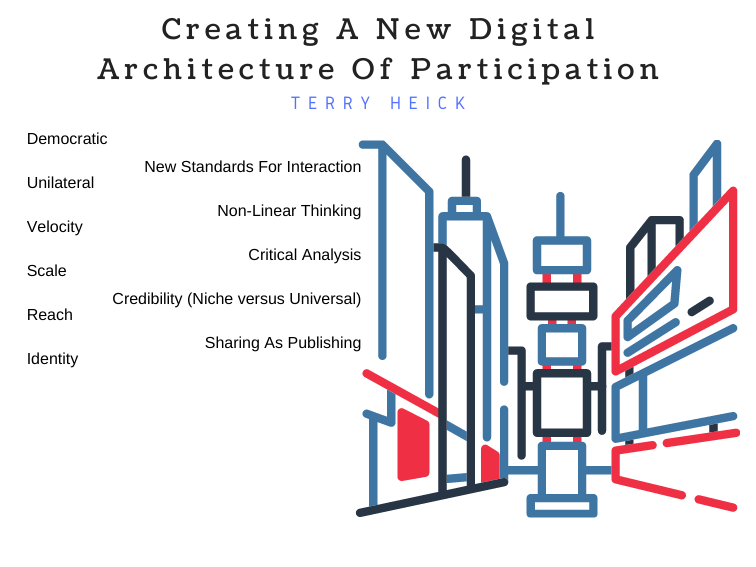
by Terrell Heick It isn’t clear what the original goal of social media was. No single person, organization, or platform could have possibly decided this. Once the framework of publishing content–in any constantly changing but not always evolving forms–was established, new standards for engagement emerged. At its best, the primary…
-
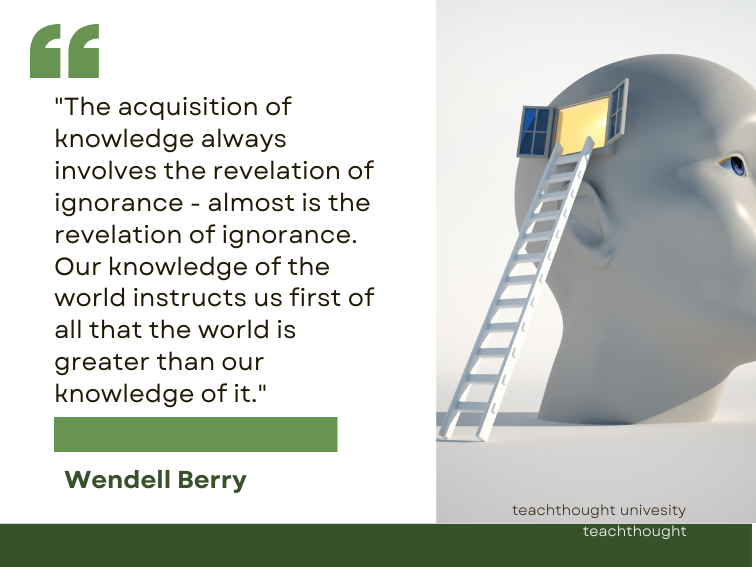
by Terry Heick Education is a series of learning experiences informed by policy, and actuated by teachers. Policy, by its very nature, is sweeping and ambitious. It is designed to work on various scales, is well-intentioned, and often difficult to fault on paper. The teachers aren’t really much different. They are…
-

by TeachThought Staff Welcome to a new school year! While most teachers and students have so much to look forward to as the new school year begins, at times the groans you will hear from the students are almost as loud as the more subtle groans of the teachers. The…
-
by TeachThought Staff Team-building activities are great–especially for the first day of school or early in the school year, Not only can they help establish routines, tone, and expectations, they’re also fun, and can help learners feel comfortable. Though many older students in high school and college may groan at…
-

by TeachThought Staff Life can be crushingly busy–especially if you’re an educator or any other profession where deadlines are constant and the pressure is, unfortunately, unrelenting. With that in mind, keeping your schedule organized and managing your time efficiently is more important than ever. With so many calendar apps available…
-
Strategies for Teaching AI Concepts Without Technology by TeachThought Staff Preface: This post is primarily for general content-area K-12 teachers (likely 6-12). Teaching AI theory, for example, is well beyond these ideas. You don’t need a wind tunnel to learn about aerodynamics or boiling water to help students understand boiling…
-
by Terry Heick My wife is a schoolteacher, and recently I’ve been listening to her online meetings. And there have been a lot of them. It’s July 2024 and a week or three from the beginning of the 2024-2025 school year in the United States depending on your local school…
-
by Terry Heick It’s possible that there is no time in the history of education that our systems of educating have been so out of touch with the communities. Growing populations, shifting communities, and increasingly inwardly-focused schools all play a role. In light of the access of modern technology, social…
-
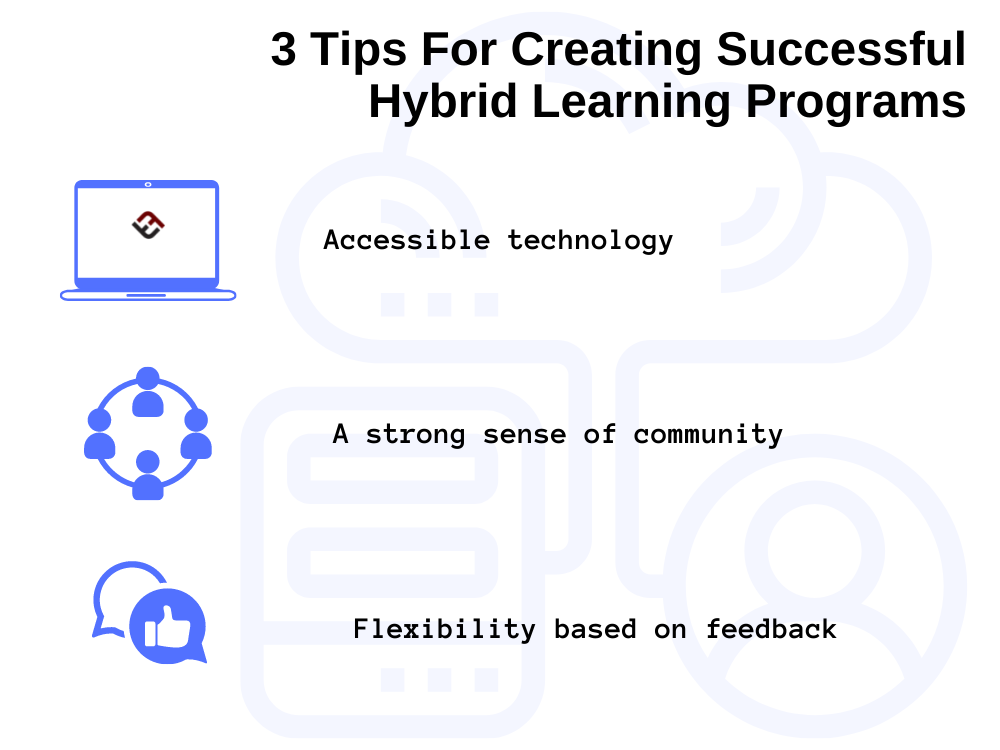
AI is quickly becoming a powerful change in online language learning (i.e., through eLearning), and it can significantly change how the material is delivered and how well learning systems work. When AI is added to eLearning platforms, they become smart tools that customize learning experiences to meet students’ needs and…
-
by Terrell Heick Will robots replace teachers? I was asked this in an interview a years ago for Futurism and tried to offer up some abstract nonsense whose lack of clarity represented my own thinking: “Will artificial intelligence replace teachers? Will the students themselves replace teachers through self-directed learning, social/digital…
-
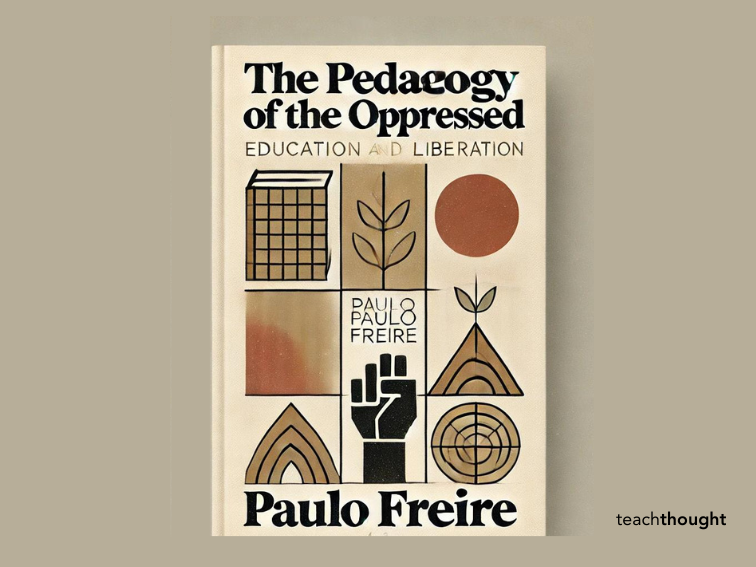
by TeachThought Staff Paulo Freire’s “The Pedagogy of the Oppressed” is a foundational text in educational theory. Its enduring significance stems from its profound critique of traditional teaching and learning methods. Written in the 1960s, this influential work remains as relevant today as it was at the time of its…
-

In the vast ocean of academic tasks, writing is a challenging and crucial skill for success at school and beyond. Whether drafting an essay, composing a research paper, or jotting down notes for class, having the right tools can make all the difference. With a wide array of digital writing…
-

Technology has transformed how you interact with your educational materials. From AI tutors that provide personalized learning experiences to digital platforms that organize notes efficiently, these innovative tools are transforming traditional learning methods. As a student, adapting to these technological advancements can significantly enhance your academic performance and make your…
-
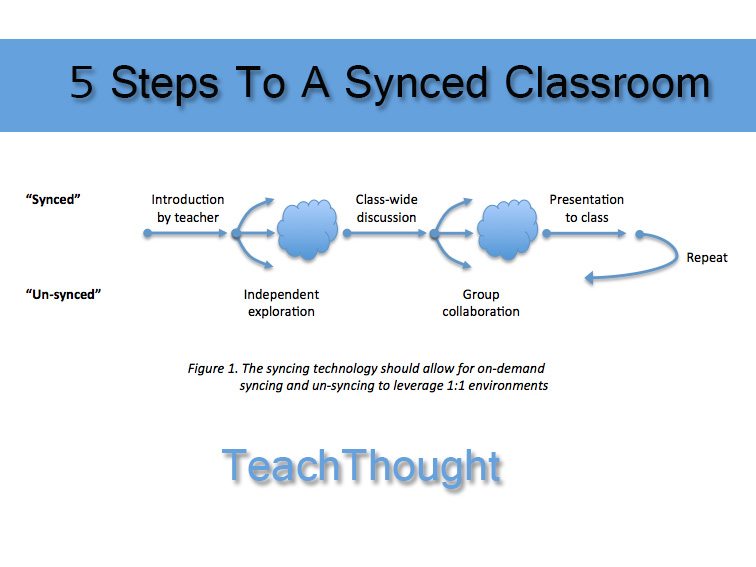
by TeachThought Staff In just the last decade, the image of technology in the classroom has shifted from rows of desktops in a dedicated computer lab (all facing the same direction) to one where a variety of different devices coexist, often uneasily, in and out of the lab. The role…
-
by Terry Heick Phonemic awareness is knowing that certain letters make certain sounds. Phonemic awareness is knowing that sounds can blend together in predictable and unpredictable ways. Phonemic awareness is about loving the sounds that letters can make, then noticing common patterns across symbols, media, and languages. Phonemic awareness makes…
-

“Let’s get out our [independent/book club/whole class] books and open to page __!” At least one student in the room experiences a shudder of disdain and a wave of despondency each time such words are uttered (many more students are likely experiencing this emotional response to the dread of reading…
-
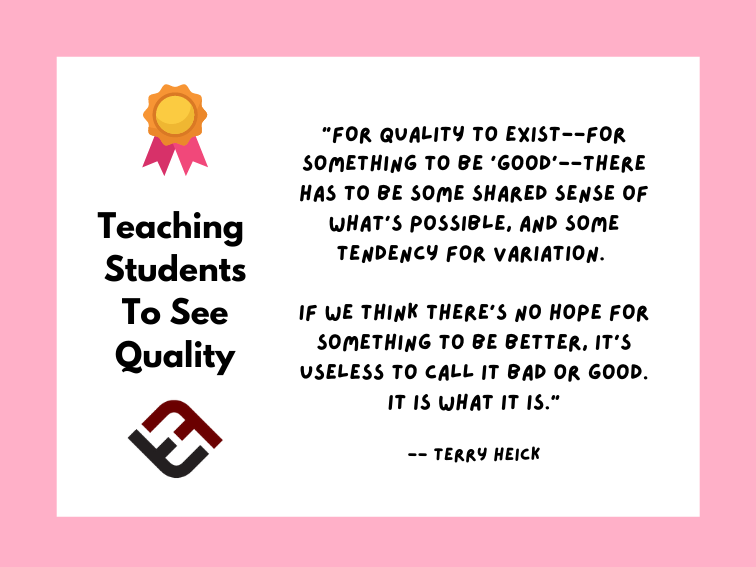
by Terry Heick Quality—you know what it is, yet you don’t know what it is. But that’s self-contradictory. But some things are better than others, that is, they have more quality. But when you try to say what the quality is, apart from the things that have it, it all…
-
Setting specific goals isn’t just about ticking off checkboxes; it’s about charting a path toward academic excellence and personal growth. As a college student, you juggle lectures, exams, and study sessions. That’s where learning goals come into play—they help you focus, measure your progress, and keep your eyes on the…
-
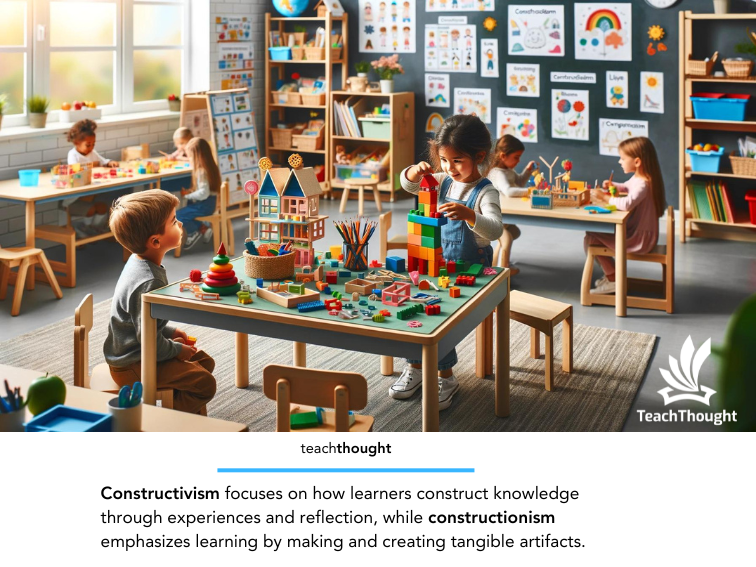
The Difference Between Constructivism And Constructionism by Terry Heick While working on the learning theory visual overview, I realized I couldn’t clearly explain the difference between constructivism and constructionism. So I did a little research and initially didn’t find much to ease my confusion. The Difference Between Constructivism And Constructionism…
-
by TeachThought Staff The field of healthcare is experiencing rapid growth globally as people live longer lives. This expansion requires knowledgeable individuals from healthcare management programs to develop strategies for providing affordable and available healthcare to more people. Advances in digital technology are transforming the healthcare industry, opening doors for…
-
by Terry Heick Having gone on for decades now, discussions around the idea of ed reform are a bit tired. They seem pointless. Exhausting. A waste of time and creative bandwidth. Bottom-up change is exhausting and top-down change is exhausting for entirely different reasons. Rather than state or federal policy,…
-
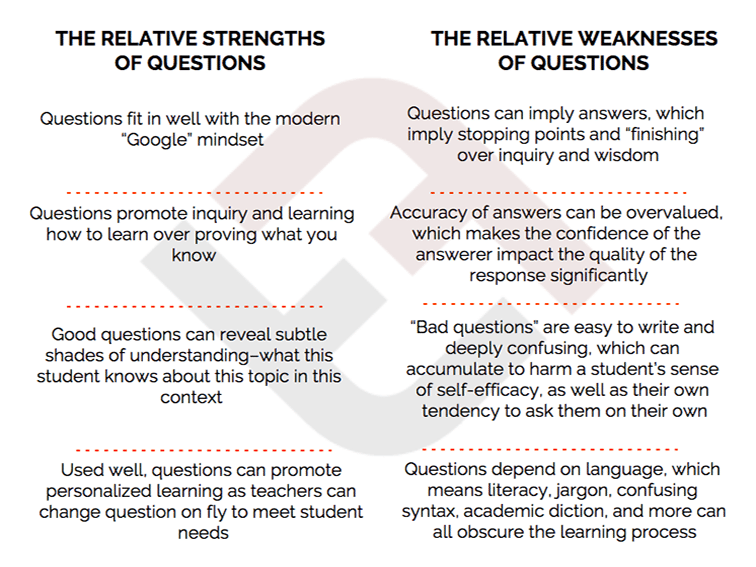
by Terry Heick If the ultimate goal of education is for students to be able to answer questions effectively, then focusing on content and response strategies makes sense. If the ultimate goal of education is to teach students to think, then focusing on how we can help students ask better questions…
-
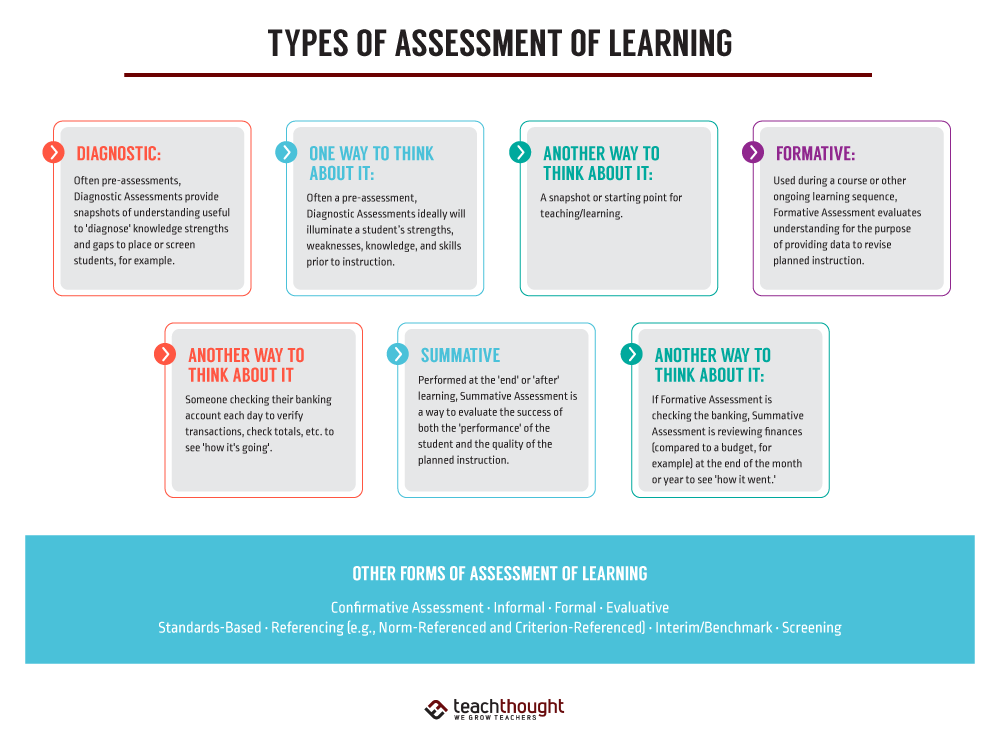
by TeachThought Staff What are the types of assessment for learning? And more importantly, when should you use which? If curriculum is the what of teaching and learning models are the how, assessment is the puzzled ‘Hmmmm’–as in, I assumed this and this about student learning, but after giving this…
-
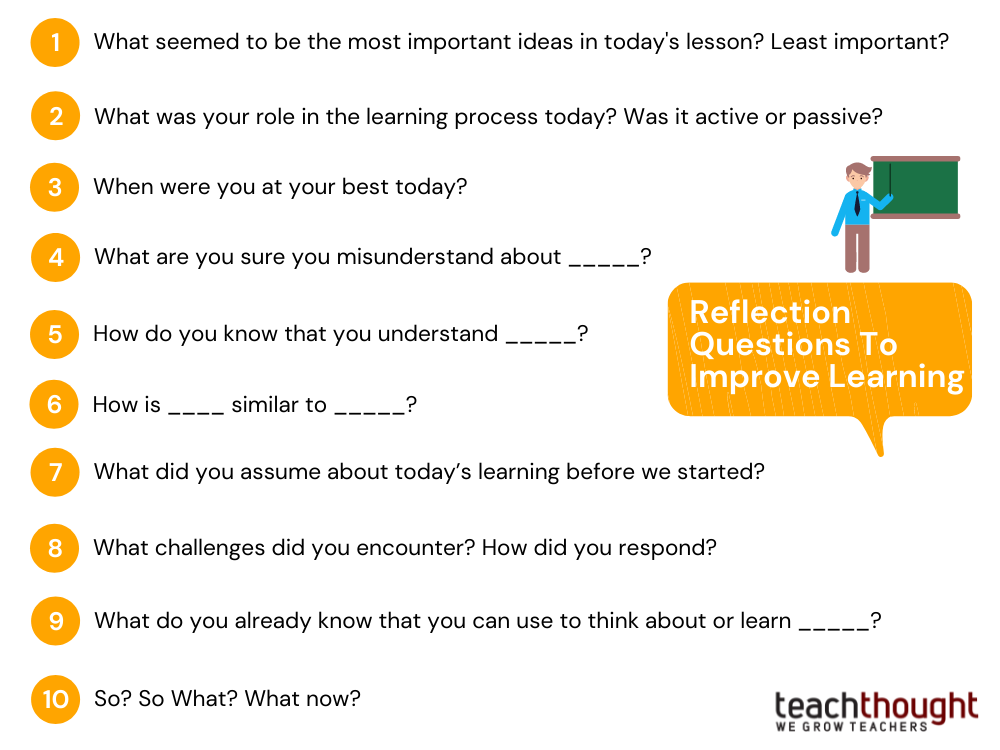
by Terry Heick A few years ago, I wrote about Types of Learning Journals and reflection was a part of this thinking. I’ve also shared a small collection of basic reflective questions in the past that could be used as a tweet or other social media post. Now, for an…
-
Embracing the Future of Social Work Through Online Education by TeachThought Staff The social work profession is on the cusp of a transformative era. Once viewed with skepticism, online education is rapidly becoming a powerful tool for expanding access to quality social work education and empowering the next generation of…
-
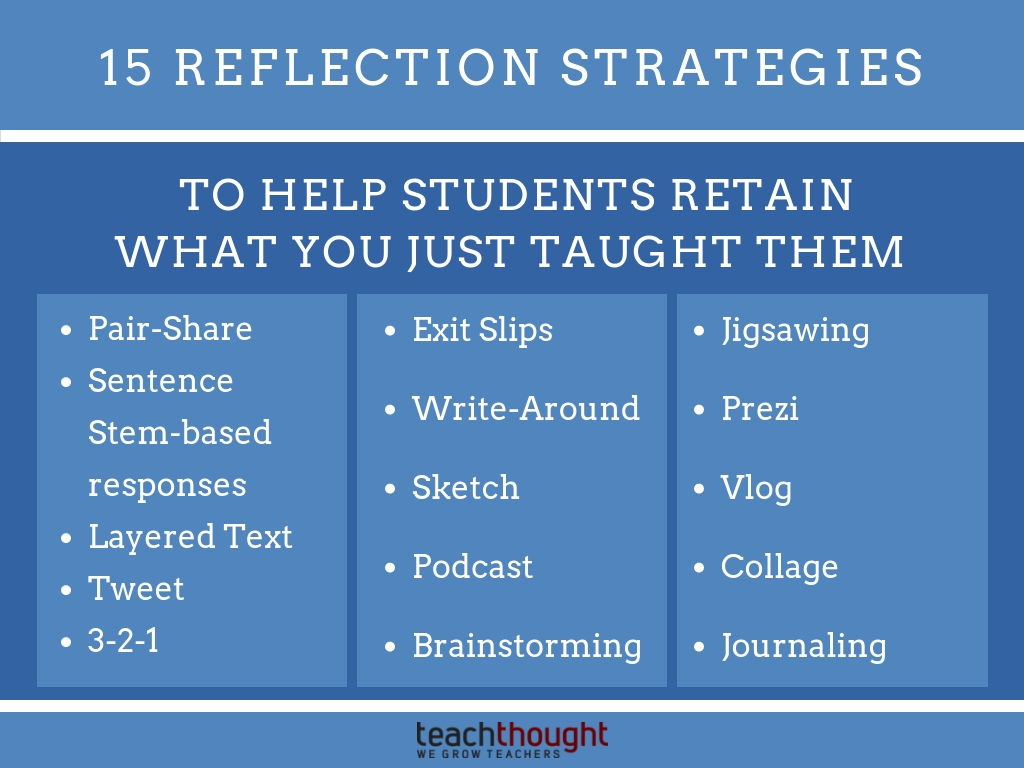
by Terry Heick Reflection is a natural part of learning. We all think about new experiences–the camping on the car ride home, the mistakes made in a game, or the emotions felt while finishing a long-term project that’s taken months to complete. Below I’ve shared 15 strategies for students to…
-

Title: Embracing Statistics: A Pillar of Modern STEM Education In today’s rapidly evolving landscape of science, technology, engineering, and mathematics (STEM), statistics is a pivotal discipline, transcending its traditional role as a mere supporting tool. As we navigate the digital age, statistics has become a cornerstone in understanding and interpreting…
-
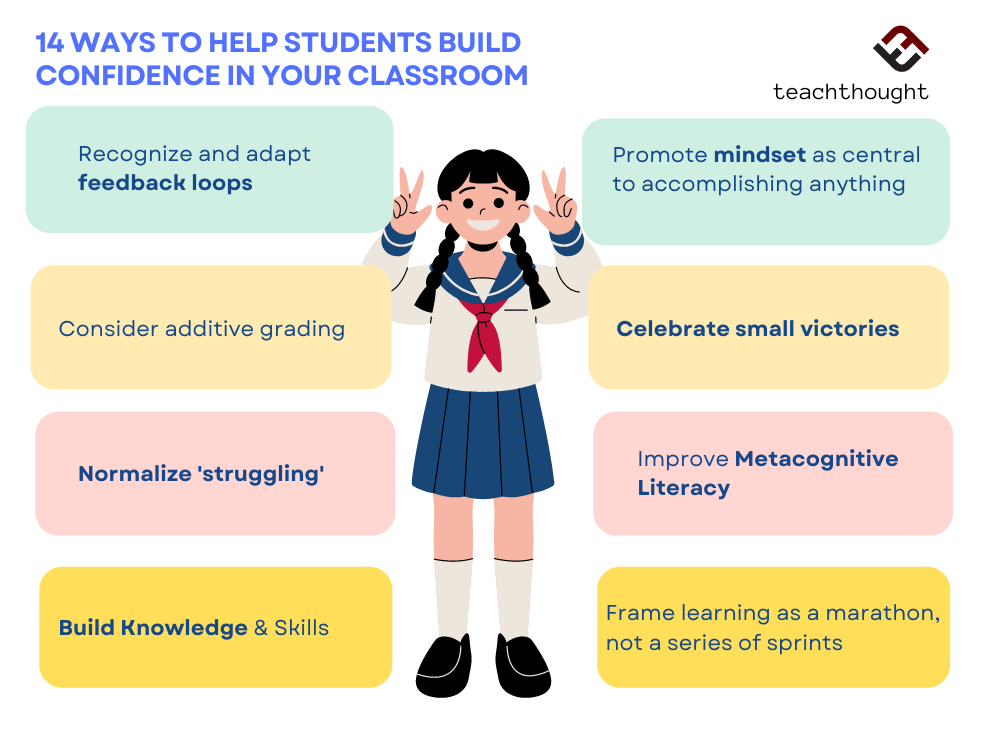
Once it’s begun, it’s difficult to fully separate the person from the task. When the artist is painting, the painter and the act of painting become a single ‘thing.’ The painting becomes a part of it all, too. As a teacher, your ‘self’ is embedded within your teaching—which is how…
-
contributed by Beth Rush, Managing Edition at Body + Mind The image of your 5-year-old sitting serenely on a yoga mat might calm your mind if you’re a harried parent, but does meditation benefit this age group? What can teachers and parents expect, and how can schools reap the perks…
-
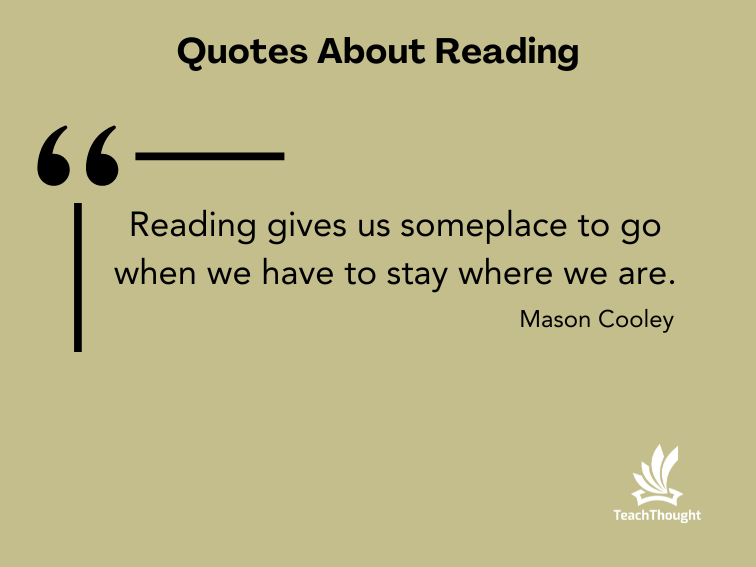
50 Of The Best Quotes About Reading by TeachThought Staff Literacy—the ability to read and write—is the foundation of formal, academic learning. But beyond reading and writing skills, literacy is a gateway to critical thinking, effective communication, and holistic learning experiences. Literacy is crucial to any learning environment, from promoting…
-
How to Transform Your Study Sessions: Notes, Help, and Hacks for the Modern Student by TeachThought Staff Transforming your study sessions from tedious to productive doesn’t just happen; it requires a mix of the right strategies, tools, and mindset. Your approach to studying can make the difference between feeling overwhelmed…
-
contributed by Edelyn Bontuyan What makes traditional learning click? In-person learning. As a teacher, your students look up to you to impart knowledge in a format and manner they can absorb fast and easy. How do you achieve that? You conduct Q&A sessions, set up discussions, conduct practicals, lead peer…
-
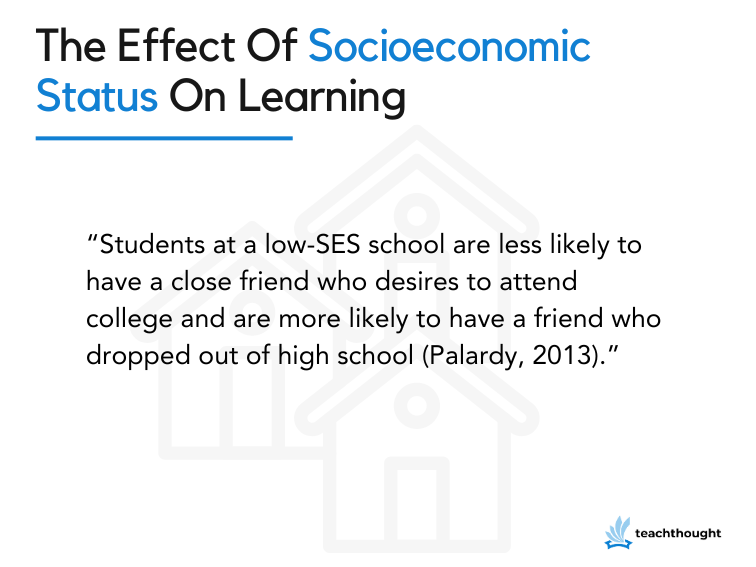
contributed by Michael Mirra Abstract Diversity has been at the forefront of educational discussions over the last few years. When we think about having a diverse classroom we think of ethnicity, race, gender, nationality, religion, and sexual orientation. It is easy for us to forget about socioeconomic status. This paper…
-
Richard Feynman On Knowing Versus Understanding by TeachThought Staff Who is Richard Feynman? Richard Feynman, born in 1918, was a theoretical physicist whose work in quantum mechanics earned him the Nobel Prize in Physics in 1965. According to nobelprize.org, Feynman obtained his B.Sc. in 1939 at the Massachusetts Institute of…
-
contributed by Barbara R. Blackburn Differentiation is a popular concept in today’s schools. After all, it makes sense. We’d all love to provide instruction tailored to every student’s needs. However, intentionally or accidentally, many teachers simply lower the rigor for struggling students. When we do that regularly, students always stay…
-
contributed by TeachThought Staff Language is a wonderful thing. It is the common thread that binds entire societies, allowing ease of communication and understanding. On the other hand, finding yourself in a situation where you are unable to communicate adequately is highly frustrating. A language barrier can stunt relationships that…
-
contributed by Dr. Kara Stern, SchoolStatus Head of Education Solutions Recognizing school/home communication’s profound impact on student success and well-being is crucial. We need to understand school communication as much more than disseminating information—it’s an integral pillar supporting student achievement, as fundamental as curriculum and instruction. Effective school/home communication is…
-
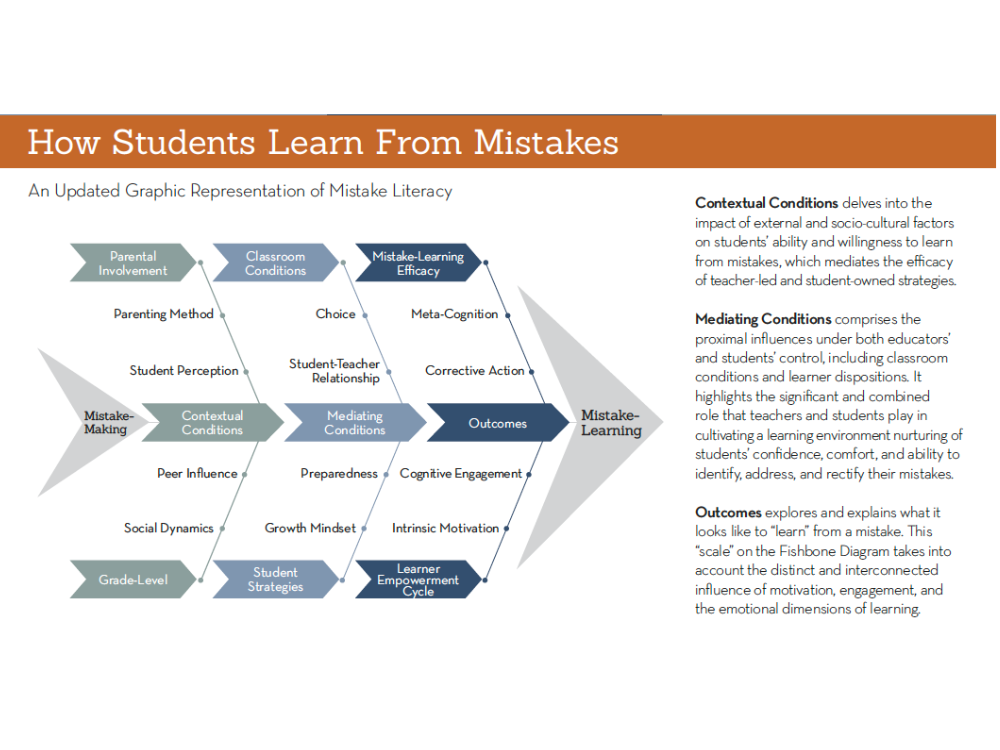
contributed by Dr. Zak Cohen In 2009, President Obama spoke to a group of students at Wakefield High School in Arlington, Virginia. As someone who had readily and unabashedly admitted to his mistakes as a youth and how these missteps informed the adult he had become, he humbly but stridently…
-
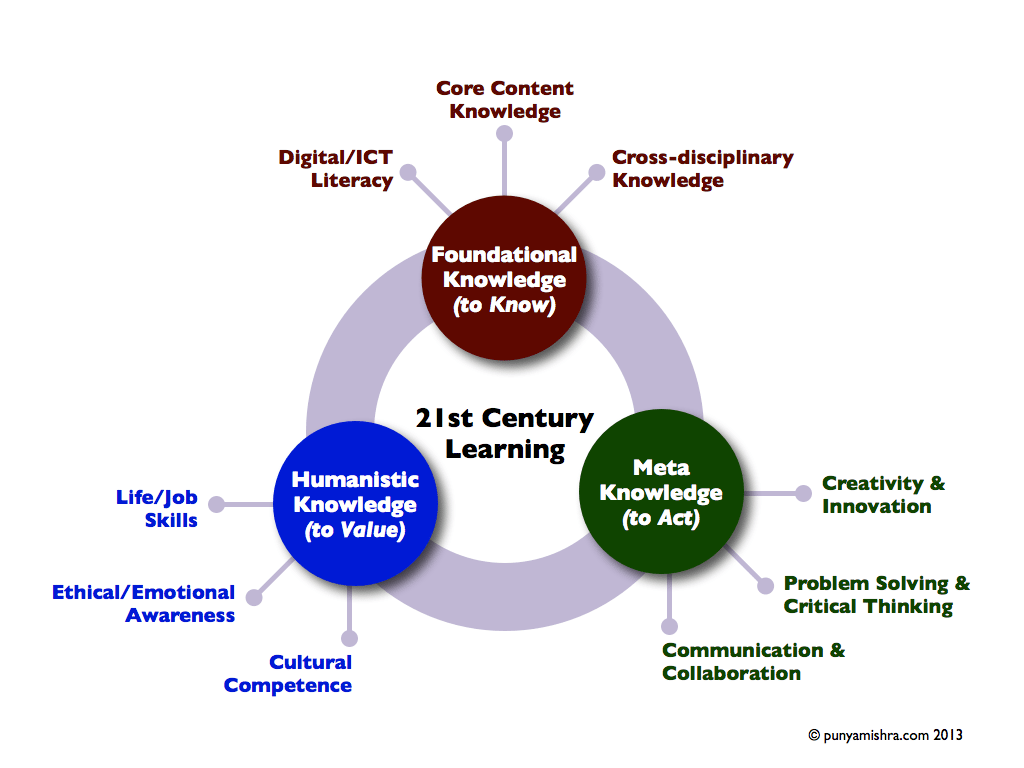
by TeachThought Staff Thinking in the 21st century is just different. That doesn’t mean we’re all suddenly omnipotent cyborgs, nor do we all become mindless social media addicts who spend our cognitive might tapping, swiping, and drooling on our smartphone and tablet screens. But just as the 19th century presented…